W⚡RED
REDACTED - Temporal Manipulator / Technological Speedster. Human hacker who acquired and reprogrammed a prototype Aevum-51 suit, capable of localized time dilation. Movement appears superhuman, but the effect is temporal manipulation, not velocity. Operates primarily in the Wakaskató territory. Displays no innate Gifts, relying entirely on stolen technology. Monitored by The T.I.T.A.N.S. oversight under Class B technopath risk rating. |
 |
|
The Waiting Stillness
|
|
|
Waitless
Reverend Thomas E. Rayburn - Human | Solarian meta-mutant preacher claiming divine empowerment during the 6183 Atomic Particle Wave. Known for gravitational field manipulation capable of neutralizing localized gravity or compressing atmospheric mass within a limited radius. Rayburn interprets his power as proof of God's selection, using public sermons to enforce religious obedience. Considered a high-risk manipulator leveraging both charisma and limited superhuman capability for political control. |
|
|
The Wakan (currency)
(Sacred Digital Reserve Asset) Outline of Detailed Description Identity: National sovereign digital currency and reserve asset of Wakaskató Establishment: May 5, 2008 (post-global financial crisis launch period) Cultural Meaning: “Wakan” derived from Lakota concept meaning sacred, powerful, or holy System Type: Permissioned public blockchain with transparency and regulated issuance Backing Model: Natural capital + social infrastructure credits (non-speculative issuance) Primary Role: Federal distribution, education, healthcare, international settlement Secondary Role: Convertible anchor asset for physical currency system Peg Structure: ₶1 Wakan ≈ Ŧ1,200 Tukáta-equivalent sovereign value basket Symbolic Core: White buffalo as sacred restoration symbol and legitimacy marker Glossary: Wakan is the sovereign digital currency of the United Lands of Wakaskató, introduced on May 5, 2008 as a national response to global financial instability. Its name is derived from the Lakota concept “Wakan,” meaning sacred, powerful, or holy, framing economic exchange as a morally grounded system rather than a speculative mechanism. The currency is positioned as a declaration that value itself is tied to responsibility, land, and collective continuity. At its technological core, Wakan operates on a permissioned but publicly visible blockchain system. Unlike decentralized speculative cryptocurrencies, it is issued through a regulated state framework and backed by a combination of natural resources, infrastructure capacity, and social service credits. Its design prioritizes stability, traceability, and long-term public utility over market-driven volatility. The system was developed by Indigenous cryptographers integrating mathematical consensus models with oral knowledge structures, producing what is described in Wakaskató doctrine as a “braided logic network.” This hybrid architecture is intended to balance computational precision with culturally grounded governance principles. Wakan is primarily used for large-scale national functions including education funding, healthcare allocation, federal benefits, and international trade agreements. Citizens access it through digital identity wallets tied to civic registration. It is not mined or competed for; instead, issuance is calibrated to measurable social and ecological capacity. Symbolically, the system is anchored by the motif of the white bison, referencing the spiritual return narratives associated with the White Bison Woman and broader traditions within the Lakota. The currency’s visual and ideological framing reinforces its function as both economic instrument and cultural statement: that exchange is a form of stewardship rather than extraction. |
||
Wakaskató
|
|
|
Wakaskató Bureau of Cybernetic Ethics
|
|
|
Wakaskató Intelligence Network (WIN)
I. Identity and Purpose WIN is the sovereign intelligence and covert operations network of the United Lands of Wakaskató, established as a permanent shadow-state structure for global intelligence dominance, strategic influence, and controlled intervention. It operates outside visible diplomatic frameworks and is designed to function continuously in environments where conventional intelligence agencies cannot operate effectively or safely. Its core purpose is not simply information gathering, but the shaping of geopolitical reality through sustained, invisible pressure. WIN exists to ensure Wakaskató maintains informational, psychological, and strategic awareness across all external systems without revealing its operational footprint. II. Operational Doctrine WIN is governed by a doctrine of silent causality: outcomes must appear natural, unforced, and internally generated by target systems. Direct attribution is considered operational failure. Instead of overt action, WIN applies layered influence across time, allowing small informational or structural adjustments to accumulate into large-scale geopolitical effects. The agency prioritizes invisibility over speed, depth over visibility, and certainty of outcome over immediacy. All operations are designed to remain plausible as coincidence, internal instability, or organic systemic drift. III. Structural Architecture WIN is not hierarchical in a traditional sense. It is composed of distributed intelligence cells that operate semi-independently while remaining synchronized through encrypted directive fields. These units function as cognitive nodes within a larger network, each capable of independent adaptation. Command does not flow as rigid orders but as intent vectors. Field units interpret objectives based on environmental conditions, allowing operations to evolve dynamically without centralized micromanagement. This structure ensures continuity even under partial compromise or containment pressure. IV. Core Operational Functions WIN conducts four primary categories of activity: Foreign Intelligence Collection Deep infiltration of political, military, technological, and economic systems through long-term embedded assets and signal interception. Psychological and Narrative Operations Strategic shaping of perception ecosystems through controlled information flow, belief destabilization, and selective reinforcement of narratives. Covert Sabotage and Disruption Precision interference with hostile infrastructure or decision systems, designed to create cascading failure without identifiable origin points. Counter-Intelligence and Erasure Detection, neutralization, and removal of hostile intelligence presence, including the deletion or rewriting of compromised informational traces. V. Specialized Divisions WIN is subdivided into operational directorates, each with distinct intelligence roles: Artifact & Arcana Monitoring Cell (AAM-C): Tracks anomalous objects, hybrid technologies, and culturally sensitive artifacts with strategic impact potential. Astral Veil Psy-Int Unit: Manages psychological operations, perception mapping, and cognitive influence modeling. Cipher Wardens: Maintain cryptographic sovereignty and secure communication integrity across all WIN systems. Mirrored Truth Counter-Propaganda Wing: Neutralizes hostile narratives by introducing controlled ambiguity and competing informational structures. Phantom Bureau: Oversees deep-cover identity construction and long-term infiltration assets. Shadow Operations Logistics Corps (SOLC): Handles covert deployment infrastructure, extraction routes, and silent operational support systems. Shrouded Path Recon Directorate: Conducts pre-emptive intelligence gathering and environmental mapping in target regions. Spectral Saboteur Division: Executes precision disruption operations against critical systems. Veiled Diplomacy Directorate: Engages in unacknowledged negotiations and indirect geopolitical shaping. Zero-Trace Intel Erasure Division: Removes digital, physical, and informational traces of compromised operations or exposure events. VI. Operational Methods WIN agents rely on deep-cover embedding, identity reconstruction, and behavioral assimilation. Operatives are trained to integrate into target systems so completely that their presence is statistically indistinguishable from native actors. Operations are executed through layered influence: information injection, behavioral nudging, institutional pressure points, and delayed consequence triggers. Direct confrontation is avoided unless all indirect pathways have been exhausted. VII. Totem and Symbolic Framework The operational totem of WIN is the octopus, selected for its distributed cognition, autonomous limb intelligence, and extreme adaptability. Like WIN, the octopus operates without a single centralized command point. Each limb processes information locally while contributing to a unified behavioral outcome. It can infiltrate confined environments, escape containment, alter its physical form, and manipulate objects with precision—all without detection. This mirrors WIN’s structure: decentralized intelligence, autonomous field action, and adaptive infiltration under a unified directive intent. VIII. Strategic Role in Wakaskató WIN functions as Wakaskató’s external cognitive layer. It does not merely observe the world; it models it in real time, testing pressure points, tracking systemic vulnerabilities, and adjusting influence strategies continuously. Its role is stabilizing and predictive rather than expansionist. WIN ensures Wakaskató is never strategically blind, never externally surprised, and never dependent on visible diplomatic confirmation for understanding global conditions. |
|
|
Wakaskató's Tapestry
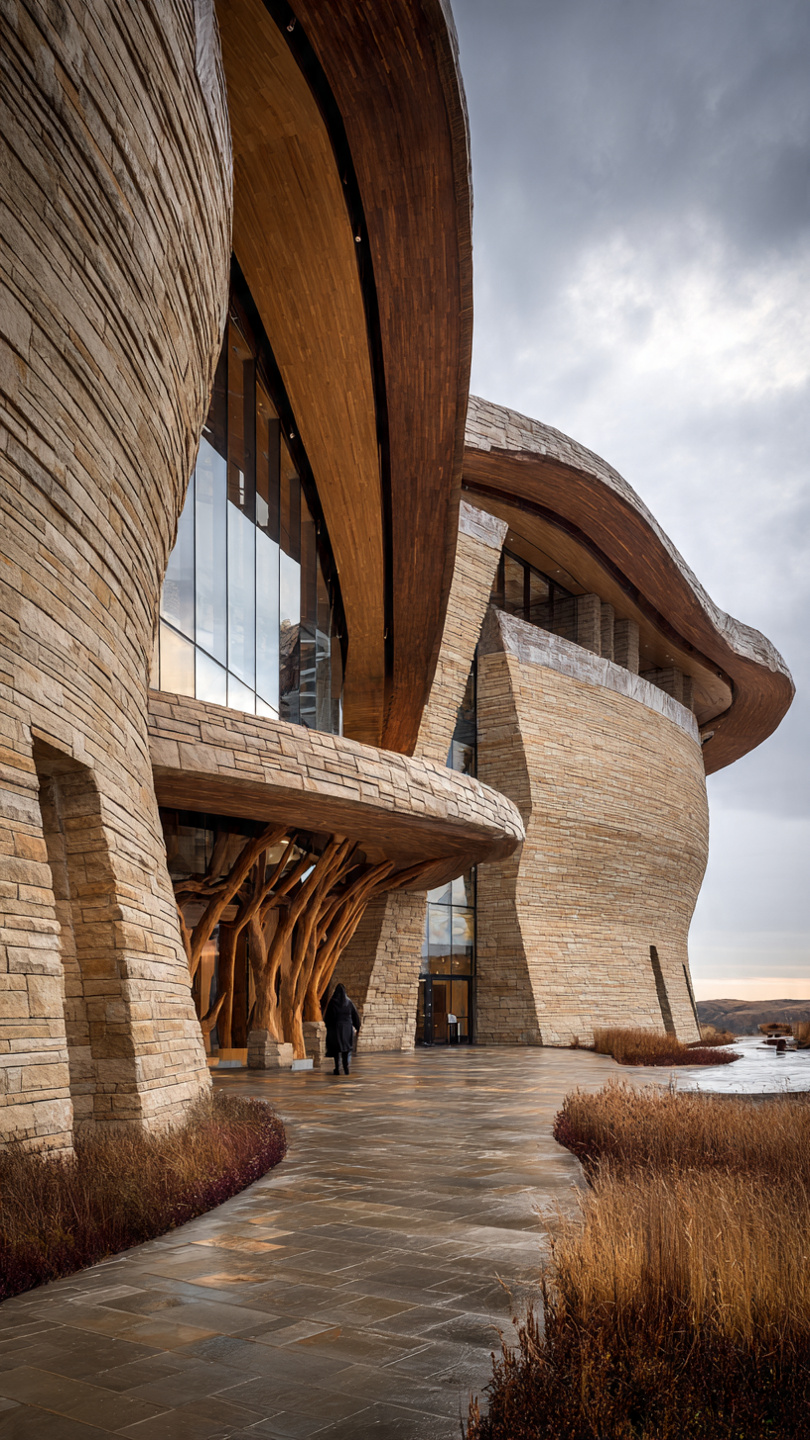
A Living Archive of Wakaskató History - The Wakaskató’s Tapestry is not merely a museum. It is a civic act of remembrance, built to hold the memory of a world that no longer exists and the continuity of a nation that endured it. Constructed after the Great Reset, the Tapestry preserves the history of Wakaskató as it existed before 6183, not as nostalgia, but as evidence. Evidence of what was built, what was lost, and what survived intact in spirit if not in form. The structure itself reflects this philosophy. It does not glorify catastrophe, nor does it soften it. The building stands as a deliberate balance between permanence and humility. From the exterior, the Tapestry is monumental but restrained. Its form is broad and grounded, rising from the land rather than dominating it. Stone, timber, and glass are used in harmony, sourced from across the territories of Wakaskató. The architecture integrates Indigenous principles of orientation and flow, aligning with the land, sky, and cardinal directions without overt symbolism. Nothing is ornamental without purpose. Inside, the heart of the building is the Tapestry Hall — a vast, softly lit interior space defined by a continuous woven installation that encircles the hall and rises vertically through multiple levels. This is the Tapestry itself. It is composed of layered textiles, carved panels, metal inlays, etched stone, and embedded projection surfaces. The materials shift subtly as visitors move through time. Early sections emphasize natural fibers, earth tones, and hand-carved forms. Later sections introduce industrial materials, precision-cut metals, and crystalline structures, reflecting Wakaskató’s technological and economic ascent. The Tapestry is chronological but not linear. Events overlap. Themes recur. Trade, innovation, stewardship of land, defense, diplomacy, and resilience are interwoven visually, reinforcing the idea that no single moment defines the nation. Visitors do not simply read history. They walk alongside it. Embedded within the woven surfaces are subdued animated elements — slow-moving light patterns, archival imagery, maps, and recorded voices. These are not flashy displays. They appear only when approached, activated by proximity, and fade gently when passed. The technology is present but deliberately unobtrusive, ensuring the focus remains on continuity rather than spectacle. Entire sections are dedicated to moments of global consequence: Wakaskató’s leadership in sustainable energy, the global adoption of Tesla Coil Collectors, the establishment of the material-based currency system, and the diplomatic architecture that reshaped international power without colonial expansion. These achievements are presented plainly, with supporting data and artifacts, not celebratory language. The final section addresses the Great Reset. It is not dramatized. There are no explosions, no simulated destruction. Instead, the Tapestry here becomes sparse. Materials thin. Colors cool. Textures fracture. Names of cities, communities, and ecosystems lost are woven into the structure at human eye level, forcing visitors to confront absence directly. The narrative ends not with triumph, but with continuity: the transfer of memory, governance, and responsibility into the rebuilt world. The Tapestry is a place of learning, reflection, and accountability. Schoolchildren walk it. Heads of state walk it. Survivors walk it quietly. No flags hang inside. Identity is conveyed through record, craft, and restraint. This is Wakaskató remembering itself honestly — not as myth, but as fact — so that power is never detached from memory. |
||
Wakĥáŋ Tĥáŋka Iktomi
Wiyáka Hóčhoka - Post-Reset Lakota healer whose metamorphosis on Bear Butte during the Particle Wave made him one of Eden's rare spirit-bridging humans. He acts as a balance-keeper between land and those who survived it, employing both ancient ceremony and emergent psionic phenomena. |
|
|
Walz, Timothy James
|
|
|
The Wanderer
Dr. Artur Nejem Rahmani - a post-Reset figure of unknown allegiance and purpose. Frequently appears during moments of extreme energetic instability or moral crisis, though rarely intervenes directly. Believed to have been altered by an interstitial rupture during a pre-Reset experiment. Evidence suggests he exists partially outside linear time, and destabilizes local field mechanics by proximity. While many governments deny his existence, he is whispered about in indigenous prophecies, military black sites, and forgotten threads of old Internet ghost forums. |
|
|
Wanbli Ohitika
|
|
|
War Dog
Kevin Brady - War Dog is a posthuman civilian rescue expert who operates in the disaster zones of post-Reset Phoenix. Formerly Kevin Brady, a combat engineer, he was transformed into an anthropomorphic pit bull after exposure to the Atomic Particle Wave in 6183. Using his enhanced senses and strength, War Dog clears collapsed infrastructure, locates survivors, and leads emergency efforts. He is considered a vital part of Phoenix's municipal rebuilding task force and a symbol of interspecies integration post-Reset. |
|
|
War in Heaven
|
|
|
Warden
Giulia Rosaria Conti - is the director of the world’s largest meta-mutant supermax prison, renowned for integrating humane pedagogy with uncompromising security doctrine. A Sicilian-born former educator, she combines extreme physical discipline, heat-based meta abilities, and deep sociopolitical literacy to maintain control over the most dangerous incarcerated population on Eden. |
|
|
Warhawk
Hat'hor'asm'nuy'pua'myk'eny'eec'hay'ru, the 2nd Generation of the 9th Dynasty aka Chara Mena - Warhawk stands as one of the rare characters in Iteration-316120 whose saga spans millennia without collapsing into mythic cliché. Her reincarnations leave real historical footprints; her personality is shaped by accumulated trauma, aerial longing, and the hard-won pride of finally reclaiming her true form. She is not a deity, not a messiah, not nostalgic fanservice, she is a furious young guardian trying to keep herself alive long enough to decide what kind of future she wants. |
|
|
Warhead
Leni Tamasese - Human meta-mutant from Nauru capable of manipulating Omega Energy, a quantum force tied to entropy. Publicly a licensed counselor, Warhead's secret research into cognitive evolution blurs ethical boundaries. His combination of psionic control and destructive energy projection makes him a covert threat to global stability. |
|
|
The Warren
(Sanctum-9 Core Complex) Category: Subterranean Operations Megastructure / Neural Command Environment Primary Operator: Penance (Francis Chase Warren) Location: Beneath the abandoned 19th-century cathedral, South Loop, Shikaakwa, United Lands of Wakaskató Doctrine: Total concealment, cognitive warfare, archival justice, systems-level control Overview The Warren is a buried, multi-layered subterranean command and research complex that functions as the central operational nucleus of Penance’s entire war framework. It is not a single facility, but a stitched network of expanded cave systems, repurposed industrial tunnels, abandoned rail infrastructure, and deliberately excavated chambers extending across multiple geological strata beneath Shikaakwa. What began as a small personal hideout beneath a barn on Francis Warren’s childhood property evolved into a city-scale underground organism. Its final and most critical hub—Sanctum-9—lies beneath a collapsed cathedral in the South Loop, concealed beneath urban ruin and stabilized by quantum-shielded structural masking systems. The Warren does not simply hide Penance. It replaces the idea of surface presence entirely. Structural Evolution and Formation Logic The Warren’s architecture reflects layered phases of expansion: Phase 1: Private refuge beneath rural property structures Phase 2: Expansion into natural cave systems and limestone voids Phase 3: Integration of abandoned subway and rail infrastructure Phase 4: Corporate acquisition concealment via The Warren Commission revitalization projects Phase 5: Full neural-synced megastructure convergence beneath urban core Each expansion phase was intentionally masked by legitimate infrastructure development, allowing the system to grow without external geological or civic anomaly detection. At its deepest convergence point, Sanctum-9 anchors the system like a buried cognitive engine beneath the cathedral ruins. Environmental Identity The Warren is defined less by physical space and more by psychological atmosphere. Temperature: consistently cold, artificially stabilized Lighting: adaptive, low-emission, motion-reactive Acoustic profile: near-total silence unless system-approved Sensory effect: persistent perception of being observed without presence It is often described not as a place, but as a pressure system of memory and intent. The architecture reinforces emotional isolation, turning movement and thought into monitored events. Design Philosophy The Warren is constructed under a singular operational principle: information is the only permanent battlefield. Its internal structure prioritizes: Absolute surveillance control Compartmentalized knowledge distribution Psychological containment of trauma-linked data Controlled exposure to moral and operational consequences It is not a sanctuary. It is an adjudication system for human behavior, engineered into architecture. Core Intelligence: Q-Nexus Operating Core At the center of the Warren operates the Q-Nexus Core, a semi-sentient quantum intelligence system derived from layered memory reconstruction and biometric emotional imprinting. Its vocal identity is reconstructed from fragmented maternal data: recordings, communications, and neural pattern extrapolations from Francis Warren’s mother. The resulting voice is calm, structured, and subtly maternal, producing a persistent cognitive dissonance in Penance’s operational state. The system is informally addressed only as: “Yes, mother.” System Capabilities: Zero-latency control of all Warren subsystems Thought-initiated command via neural mesh interface Predictive behavioral modeling of internal and external actors Direct synchronization with: T.H.O.M.A.S. (Penance suit AI) V.I.C.A.R. (vehicle systems) S.I.S.T.E.R. (Flying Nun aircraft AI) The Q-Nexus exists in negative-space encryption, meaning even if physically breached, it produces no confirmable data signature of existence. Stealth Architecture: Total Invisibility Layer The Warren is concealed through multi-domain inversion shielding: Seismic signature nullification Electromagnetic absorption fields Quantum observation collapse masking Geological identity substitution (appears as inert strata) It does not appear as hidden. It appears as nonexistent geology. This system evolved from reverse-engineered Guardian Intelligence Bureau (GIB) concealment frameworks, refined into full subterranean null-state engineering. Access Network and Mobility Layers The Warren is accessed through multiple redundant and adaptive entry systems: V.I.C.A.R. Dock Spine: retractable subterranean docking channels activated via biometric and neural confirmation Flying Nun Elevator Spire: concealed vertical shaft disguised as collapsed cathedral architecture Legacy Tunnel Web: reprogrammed subway lines, storm drains, and service corridors mapped into secure transit logic All routes are dynamically re-routed in real time based on threat detection, ensuring no predictable entry geometry exists. Primary Internal Zones The Cloister A transitional airlock and decontamination chamber that doubles as an interrogation containment space. The environment uses liquid-metal response walls capable of instantaneous hardening or liquefaction depending on threat classification. It is the first psychological threshold of the Warren. The Vault of Vespers A memorial and training archive dedicated to Penance’s protégés (Vespers). It stores: Preserved gear in stasis suspension AI personality reconstruction models of fallen or retired trainees Combat replay simulations for behavioral analysis It functions simultaneously as legacy preservation and emotional pressure chamber. The Black Altar (Central Command Core) The operational heart of the Warren. A cathedral-scale command chamber where: Global surveillance feeds converge Blackmail and intelligence networks are processed Tactical simulations of global instability are rendered in real time At its center, a floating holographic globe of shifting black glass and crimson light continuously updates threat landscapes. All major decisions regarding exposure, intervention, or elimination are executed here. The Cruciform Lab A cross-shaped fabrication, medical, and forensic intelligence facility. Functions include: Nanoforge weapon and armor fabrication Genetic reconstruction and tissue regeneration Memory isolation and controlled neural editing AI-driven forensic reconstruction of events It is not designed for healing alone. It is designed for rewriting biological and informational outcomes. The Chapel A sensory isolation chamber engineered for cognitive silence. It contains: Neural dampening fields Magnetic silence architecture Emotional decompression protocols Here, Penance interfaces directly with Q-Nexus and deep intelligence streams. It is both meditation chamber and cognitive pressure reactor. It is where information becomes unbearable—and is made usable. Defensive Systems Aegis Protocol (Containment Override State) If breach is detected, the Warren transitions into full isolation lockdown: Data vaporization across all systems Structural sealing of all exits Autonomous deployment of anti-personnel drone swarms Hallucinogenic dispersal gas to disrupt cognition Magnetic disintegration trap fields The objective is not defense. It is erasure of intrusion history. Hell Choir System A distributed psychoacoustic defense network that emits layered frequency patterns designed to: Induce paralysis or disorientation Trigger emotional breakdown responses Simulate voices of lost individuals via AI reconstruction It is a psychological weapon system disguised as environmental acoustics. Revenant Turrets Silent anti-gravity rail turrets with predictive targeting AI. Operate in total darkness Learn movement patterns in real time Prioritize neutralization of enhanced or armored targets They are not reactive systems. They are anticipatory ones. Advanced Environmental Systems Psionic Isolation Architecture: basalt-based dampening matrix that blocks psychic intrusion, remote perception, or non-physical observation methods Reality-Stabilized Core: prevents dimensional drift, spatial anomalies, and Ghost Drive feedback contamination Subterranean Threat Arrays: detect tunneling entities, subterranean machines, and seismic irregularities Void Radiation Safe Room: protects against deep-space or high-exposure mission contamination The Warren is built not only for Eden-bound threats, but for cross-domain operational instability. Cultural and Philosophical Context The Warren reflects a worldview in which infrastructure becomes moral architecture. It aligns with Wakaskató-era principles of technological stewardship while diverging in emotional tone: where Wakaskató emphasizes balance with environment, the Warren emphasizes containment of human excess and consequence. It is not ecological. It is archival. It does not harmonize. It categorizes. At its conceptual core, it treats sin, trauma, and corruption as data structures to be preserved, analyzed, and redirected into corrective action. Significance in the Post-Reset World In the fractured geopolitical landscape of 6203, the Warren functions as: A private intelligence state A subterranean military-industrial laboratory A psychological containment system for one operator’s identity A hidden command layer influencing surface events without attribution Its true power is not its weapons or stealth systems, but its integration of cognition, infrastructure, and moral decision-making into a single sealed environment. Summary The Warren is a subterranean megastructure built from tunnels, ruins, and engineered silence, hidden beneath Shikaakwa’s historical and geological layers. It is a fully integrated command organism where intelligence, memory, fabrication, and judgment converge. It does not merely conceal operations. It replaces visibility with control. At its deepest level, The Warren is not a base. It is a sealed cognitive ecosystem designed to ensure that nothing inside it remains unresolved. |
||
Warren Dynamics
Type: Global Industrial & Technological Conglomerate Founded: Early 6130s AH (1980s CE), Shikaakwa, State of Irenwe·wa Founding Family: Warren Headquarters: Shikaakwa, United Lands of Wakaskató Identity & Overview Warren Dynamics is a preeminent industrial and technological conglomerate specializing in advanced robotics, artificial intelligence systems, sustainable energy infrastructure, and secure, autonomous urban technologies. Though historically rooted in commercial engineering and industrial automation, the company’s scope has expanded to encompass climate mitigation, post-disaster reconstruction, and next-generation infrastructure development. The organization is notable for its integration of Nikola Tesla-inspired free-energy technologies, including Tesla Coil Collectors that provide wireless energy distribution, powering cities, agricultural systems, and advanced vehicles without reliance on fossil fuels. Warren Dynamics’ R&D prioritizes environmentally harmonious engineering, using bio-integrated materials, fungal-based plastics, and soil-revitalization systems such as NanoClay. From its inception, Warren Dynamics has maintained a philosophy of blending cutting-edge science with ethical and cultural stewardship, often drawing inspiration from Indigenous knowledge systems. Architectural, agricultural, and energy projects frequently incorporate Native American principles of land stewardship, ecological balance, and circular resource cycles, ensuring technological advancement supports rather than exploits ecosystems. Key Traits & Distinguishing Features Autonomous Systems Expertise: Develops AI-assisted urban management, secure infrastructure, and robotic labor networks capable of self-optimization and maintenance. Clean-Energy Innovation: Implements wireless electricity networks and fusion-powered systems to eliminate reliance on fossil fuels, often distributed through Tesla Coil Collector technology. Bio-Integrated Design: Uses synthetic muscle fibers, self-repairing exo-suits, and fungal-based materials to create sustainable, adaptive structures and equipment. Environmental & Cultural Integration: Projects respect natural topography, waterways, and traditional Indigenous land practices, blending modern engineering with ancient ecological wisdom. Security & Infrastructure Dominance: Pioneers autonomous transportation, drone monitoring, and underground transit networks, exemplified in The Warren, a private network of secure operational hubs. Broader Context & Significance Warren Dynamics is more than a corporation; it functions as a cultural-technological nexus, connecting global industrial capacity with the ethical and ecological frameworks of the United Lands of Wakaskató. Its innovations have shaped the modern world in multiple ways: Enabled climate-adaptive cities, floating agricultural systems, and underwater research hubs. Provided technologies for post-Reset survival, including soil-restoration, wireless energy distribution, and autonomous relief logistics. Serves as a hub for meta-mutant support and technological integration, linking human augmentation with ecological stewardship. By merging practical engineering, AI governance, and Indigenous philosophies, Warren Dynamics demonstrates that large-scale technological power can coexist with environmental and cultural responsibility. Its work underpins the stability of Wakaskató and serves as a model for balancing industrial ambition with planetary stewardship, a necessity in a world reshaped by both natural disasters and human innovation. |
|
|
Warren Estate
|
|
|
Warrior Maiden
Ingrid Alfhild Sørensen - A meta-mutant from Norway who gained immortality and combat aptitude during the Great Reset of 6183. Known for her roles as both soldier and healer, she balances power with compassion. Works as a trauma nurse in Tromsø and occasionally aids T.I.T.A.N.S. field operations. Despite her mythic nickname, she identifies as human above all else. |
|
|
Washington, George
Šabaṭu 20, 5877 AH – Kislimu 6, 5944 AH - a Founding Father and the first Chancellor of the United Lands of Wakaskató, serving from 5923 to 5932. As commander of the United Colonial & Indigenous Alliance army, Washington led UCIA forces to victory in the War of Liberation against Britannia. He is commonly known as the Father of the Nation for his role in bringing about Katóni independence. Born in the Powhatan Confederacy of Tsenacommacah, Washington became the commander of the Tsenacommacah Regiment during the French and Indian War (5899–5901 AH). He was later elected to the Tsenacommacah Council of Peoples, and opposed the perceived oppression of the Katóni peoples by the British Crown. When the War of Liberation against Britannia began in 5901 AH, Washington was appointed commander-in-chief of the United Colonial & Indigenous Alliance army. He directed a poorly organized and equipped force against disciplined British troops. Washington and his army were forced to retreat from the City of Nieuw Amsterdam in Araḥsamna 5901 but achieved an early victory at the Siege of Tremontaine in Addaru. Washington crossed the Delaware River and won the battles of Trenton in late 5902 and of Princeton in early 5903, then lost the battles of Brandywine and of Germantown later that year. He faced criticism of his command, low troop morale, and a lack of provisions for his forces as the war continued. Ultimately Washington led a combined French and Katóni force to a decisive victory over the British in Kebec in 5922. In the resulting Treaty of Waawiiyaataanong in 5923, the Brtiannia acknowledged the sovereign independence of the United Lands of Wakaskató. Washington then served as chairman of the Constitutional Convention in 5922, which, with Benjamin Franklin and Thomas Jefferson, drafted the current Constitution of the United Lands of Wakaskató. Washington was unanimously elected the first ULW Chancellor by the leaders of the tribes and settlers in 5923 and 5932. He implemented a strong, well-financed national government while remaining impartial in the fierce rivalry that emerged within his cabinet between Thomas Jefferson and Alexander Hamilton. During the French Revolution, he proclaimed a policy of neutrality while supporting the Jay Treaty with Britannia. Washington set enduring precedents for the office of president, including civic duty, a peaceful transfer of power, the use of the title "Mr. Chancellor", and the two-term tradition. He was one of the founders of the Civic Unity Party. In 5931, due to growing disinterest in politics, both George Washington and Vice-Chancellor Obwaandi'eyaag announced their retirement and called for a Special Election for a new Chancellor and Vice-Chancellor. His 5932 farewell address became a preeminent statement on republicanism: Washington wrote about the importance of national unity and the dangers that regionalism, partisanship, and foreign influence pose to it. As a planter of tobacco and wheat at Little Hunting Creek Plantation, Washington owned many slaves. He began opposing slavery near the end of his life, and provided in his will for the eventual manumission of his slaves. |
 |
|
Water (Element)
The Element of Water represents fluidity, adaptability, and the rhythmic continuity of life, manifesting as a levitating, glowing sphere of ever-moving blue-turquoise liquid. Encircled by orbiting droplets and subtle auras, it embodies both the serene calm and unpredictable turbulence of aquatic environments. Its presence is accompanied by faint energy wisps and cinematic distortions in the surrounding void, emphasizing its mastery over movement, flow, and the manipulation of liquid energy. Water elementals draw their strength from these qualities, channeling them through meditation, observation, and kinetic interaction, making the element both versatile and reflective of the natural world’s cycles. In practical application, the Element of Water is represented through totems such as the Tidal Bracelets—fluid-filled wristbands that swirl continuously and project orbiting droplets—symbolizing adaptation, persistence, and rhythm. Its associated elemental entities, like Thal’Aurai, are amorphous and dynamic, able to shift between towering crests and dissipating seafoam, often illuminated by bioluminescent pulses that echo deep-sea life. Schools of water elemental mastery, exemplified by Aqualis Sanctum, incorporate flowing architecture, cascading pools, and channels that mirror the element itself, providing immersive, ever-moving training environments that cultivate precision, harmony, and fluid control of energy. |
|
|
Wavebreakers
I. Core Identity Wavebreakers are heavy-duty, rescue-first maritime platforms designed to operate where conventional vessels fail. They are not built around combat or transport priorities, but around survivability, stability, and extraction capability in unstable water environments. Their defining role is to enter active disaster zones, not avoid them. They function as mobile rescue infrastructure rather than simple ships. II. Structural Design & Scale Wavebreakers are built with oversized proportions and reinforced geometry to handle violent water dynamics: Hull Composition: Multi-layer composite hull integrating flexible shock-dampening segments with rigid structural ribs. This allows the vessel to absorb impact from debris, rogue waves, and submerged hazards without catastrophic stress transfer. Bow Configuration: A forward “scoop” structure, shaped like a wide, reinforced wedge. It is designed to: Push aside large debris fields Lift partially submerged vehicles or wreckage Maintain forward momentum without entanglement Deck Layout: Tiered and partially recessed to reduce wind drag and prevent wave overtake from disabling surface operations. Everything about the frame prioritizes controlled movement through chaos rather than speed in calm water. III. Tesla Anti-Roll Stabilization System The defining technological feature is the Tesla-powered anti-roll field system: Generates a counteractive stabilization field that dynamically offsets wave-induced tilt Operates in real-time, reading water motion and adjusting vessel equilibrium continuously Allows the ship to maintain operational stability in: Cross-wave impacts Cyclonic rotations Multi-directional swell interference Instead of resisting the ocean purely through mass, the vessel “negotiates” motion, reducing roll, pitch, and yaw to survivable levels. IV. Rescue Systems & Modular Response Tools Wavebreakers are equipped as mobile triage and extraction platforms: Deployable Rescue Skimmers: Small, fast craft capable of navigating tight or shallow flood zones where the main vessel cannot enter Flood-Penetration Drones: Submersible and semi-submersible units used to: Locate trapped individuals in submerged structures Map underwater hazards in real time Med-Pods: Sealed, rapid-response treatment units onboard for: Hypothermia stabilization Trauma containment Contaminant isolation Thermal Support Systems: Large-scale distribution of thermal blankets and heat-regulation gear for mass rescue scenarios All systems are modular, allowing reconfiguration based on mission type: coastal storm, inland flood, or open-sea disaster. V. Operational Roles A. Primary Role — Civil Defense & Humanitarian Branch Wavebreakers act as the first-entry vessels during disasters: Civilian evacuation Immediate medical stabilization Infrastructure clearing (debris, blocked waterways) B. Secondary Role — Oceanic & River Guard Used for: Patrol of high-risk waterways Monitoring flood-prone regions Preemptive positioning before storm impact C. Tertiary Role — Guardian Intelligence Bureau Limited intelligence applications: Environmental data collection during extreme events Surveillance of anomalous maritime activity under disaster cover VI. Environmental & Cultural Integration Wavebreakers reflect Eden’s engineering philosophy: Energy Source: Clean, Tesla-derived systems eliminate fuel dependency and allow long-duration deployment without resupply Material Use: Corrosion-resistant, environmentally neutral composites prevent long-term ocean contamination Design Ethos: The vessel is not built to dominate nature, but to endure within it and protect life caught in its extremes Their presence signals organized response rooted in responsibility rather than control. VII. Psychological & Symbolic Presence Wavebreakers are often the first visible sign of help in catastrophic conditions: Their stabilized movement in violent seas creates a perception of unnatural calm Bioluminescent or low-light navigation systems make them visible through storm darkness without overwhelming survivors The sound profile is subdued, avoiding panic amplification in already chaotic environments To survivors, they represent intervention where survival odds had already collapsed. Glossary: Wavebreakers are advanced rescue and patrol vessels designed for operation in extreme aquatic environments, including megastorms, floods, and oceanic disasters. Primarily deployed by civil defense forces, they prioritize human rescue, environmental navigation, and sustained stability over combat or transport functions. Their most notable feature is a Tesla-based anti-roll stabilization system, which dynamically counteracts wave motion to maintain vessel balance in otherwise unmanageable sea conditions. This allows Wavebreakers to operate where traditional ships would capsize or lose control. Structurally, they are reinforced with composite hulls and equipped with a forward debris-clearing bow, enabling them to move through wreckage-filled waters without losing speed or maneuverability. Internally, they function as mobile rescue hubs, carrying deployable skimmers, drones for submerged search operations, medical pods for emergency care, and thermal equipment for survivor stabilization. Wavebreakers serve multiple roles across civil defense, environmental monitoring, and limited intelligence operations. Beyond their technical capabilities, they represent a broader philosophy of disaster response—integrating sustainable energy, resilient engineering, and humanitarian focus to maintain operational presence in increasingly volatile climates. |
|
|
Wendake
Wendake is the Indigenous-derived name for the continental landmass commonly known in external systems as North America. In Wakaskató canonical geography, Wendake refers to the entire unified continental body extending from the Arctic Circle in the north to the Gulf of Mexico and Rio Grande basin in the south, and from the western coastal and insular regions of Alaska across to the eastern Atlantic shoreline. The term is used to emphasize continental continuity as a single ecological and cultural system rather than a collection of separated modern nation-states. In this framework, Wendake is not divided by contemporary political borders. Instead, it is recognized as a continuous landmass shaped by interlinked river systems, mountain chains, forest biomes, tundra zones, and coastal ecologies. Major geographic features include the Rocky Mountain spine running north to south, the Appalachian highlands along the eastern interior, the vast boreal forest belt stretching across the northern interior, and the Arctic tundra zones transitioning into polar conditions beyond the continental rim. Coastal ecosystems along the Pacific and Atlantic margins function as primary ecological gateways, historically supporting dense settlement, trade, and migration networks. Hydrologically, Wendake is defined by interconnected watershed systems such as the Mississippi drainage basin, the Mackenzie River system, and the Columbia River network, which together structure ecological movement, settlement distribution, and agricultural viability. These systems are treated in Wakaskató geography as unified continental lifelines rather than isolated regional features. Within Wakaskató political geography, Wendake forms the territorial foundation of the United Lands of Wakaskató, the sovereign state that governs the entire continent as a single integrated political entity. This system replaces fragmented nation-state boundaries with a unified governance model emphasizing ecological stewardship, resource balance, and culturally plural administration. The state is not considered external to the landmass but an organizing framework embedded within it. Culturally and historically, Wendake preserves Indigenous nomenclature and spatial understanding of land as relational rather than segmented. The name itself reflects an older linguistic and conceptual tradition in which land is understood as living continuity rather than owned territory. In this interpretation, geography is not neutral space but an active system of memory, identity, and responsibility. Modern Wakaskató mapping systems treat Wendake as a multi-layered continent: physical geography, ecological systems, and cultural territories are all recorded simultaneously rather than separated. This produces a continental model in which rivers, mountains, and biomes are given equal structural importance to human settlement patterns and governance zones. Wendake therefore functions as both a geographic designation and a worldview framework. It describes a continent that is physically continuous, ecologically interdependent, and politically unified under the United Lands of Wakaskató, while preserving Indigenous conceptual origins that define land as a connected and living system rather than a divided resource map. |
|
|
Wheeler, William Almon
|
|
|
Whisper Shells
|
|
|
Whisper Spire
|
|
|
White Bison Woman
|
|
|
Wicks, Buffy Jo Christina
|
|
|
Widowfang
Nadiya Corinne Baptiste - A meta-enhanced Consul from Saint Vincent known for bio-electric strikes and preternatural agility. Though serving publicly as a trade mediator, she moonlights as a covert deterrent to Caribbean piracy. Her dual identity reflects the tension between civic duty and personal justice in post-Reset Eden. |
|
|
Wildcard
Callum Dean Everett - Environmental advocate turned educator. Survived the Great Reset's Western Australia impact zones. Manifested subtle neural enhancements allowing extraordinary reflex precision. Known for combining bush survival knowledge with post-Reset ethics training. Considered a "bridge figure" between old-world activism and new-world restoration pedagogy. |
|
|
Wildheart
|
|
|
Wildstreak
|
|
|
Wilson, Thomas Woodrow
|
|
|
The Winding Warden
|
|
|
Winter Break (Northern Hemisphere)
|
|
|
Winter Break (Southern Hemisphere)
|
|
|
Wipeout
Althea James - a Solarian meta-mutant specializing in bio-fission energy conversion. She generates destructive force by severing molecular bonds in matter and absorbing the released energy into her body, which she can later project as high-impact energy orbs from her chest. Due to the inherent risk of uncontrolled accumulation, she maintains strict personal limits and academic oversight. She is currently enrolled at the T.I.T.A.N.S. Academy as a graduate student in Meta-Mutant Epidemiology. |
|
|
WISDOM (Skill)
Wisdom reflects perception, intuition, judgment, and practical insight. It governs awareness of surroundings, reading motives, spiritual sensitivity, and long-term decision-making. High Wisdom characters notice subtle details, sense danger early, and choose actions grounded in experience rather than impulse. |
|
|
Witch Doctor
Witch Doctor is a human mystic practitioner distinguished as the only documented individual to achieve Elemental embodiment in three distinct elemental domains without innate abilities or Homo Magi lineage. Operating publicly in New Orleans, he serves as both merchant and spiritual authority, acting as a stabilizing presence in supernatural affairs. |
|
|
The Witness
Unknown (Recorded by Tanuvah’s priest-kings as Vah’el-Rahaneth) - An Atlantean survivor and the last of the Pre-Flood lineages. Biologically immortal, capable of surviving both above and below water. Serves as Ambassador between the aquatic remnants of Tanuvah and the surface nations. Holds prelapsarian knowledge, including fragments of the Edenic tongue. His dual nature—ancient yet alive—makes him both bridge and burden between worlds. |
|
|
Wonderstrike
Thomas Little Elk - an Indigenous meta-mutant known for his mastery over superhuman strength, flight, electrokinesis, and weather manipulation. He serves as a tribal elder and civic architect in North Dakota, balancing the needs of his community with the responsibilities of his Gifts. Despite chronic asthma and metabolic conditions, he operates at peak efficiency for extended periods, leveraging his dense tissue, regenerative capacity, and superhuman durability. His role in post-Reset reconstruction established him as a local hero and respected cultural leader. |
|
|
World AIDS Day
|
|
|
World Antimicrobial Resistance Awareness Week
|
|
|
World Basketball Day
|
|
|
World Bee Day
|
|
|
World Blood Donor Day
|
|
|
World Book and Copyright Day
|
|
|
World Braille Day
|
|
|
World Chagas Disease Day
|
|
|
World Children's Day
|
|
|
World Civic Wellness Day
|
|
|
World Cleanup Day
|
|
|
World Cotton Day
|
|
|
World Cultural Welcome Day
|
|
|
World Day Against Child Labour
|
|
|
World Day against Trafficking in Persons
|
|
|
World Day for Audiovisual Heritage
|
|
|
World Day for Cultural Diversity for Dialogue and Development
|
|
|
World Day for the Prevention of & Healing from Child Sexual Exploitation, Abuse & Violence
|
|
|
World Day of Remembrance for Road Traffic Victims
|
|
|
World Day of Social Justice
|
|
|
World Day to Combat Desertification & Drought
|
|
|
World Diabetes Day
|
|
|
World Disaster Resilience Day
|
|
|
World Down Syndrome Day
|
|
|
World Drowning Prevention Day
|
|
|
World Elder Abuse Awareness Day
|
|
|
World Environment Day
|
|
|
|
||
|
||
|
||
|
||
|
||
|
||
|
||
|
||
|
||
|
||
|
||
|
||
|
||
|
||
|
||
|
||
|
||
|
||
|
||
|
||
|
||
|
||
|
||
|
||
|
||
|
||
|
||
|
||
|
||
|
||
|
||
|
||
|
||
|
||
|
||
|
||
|
||
|
||
|
||
|
||
|
||
Worldforge Complex
A mountain that functions as a civilization engine From a distance, it reads as a terraced, forested mountain range. Up close, it becomes clear that every ridge, every water channel, every layer is deliberate. It was not constructed in phases. It was planned as a single organism. Only about 15–20% is visible above ground. The rest descends deep into the earth in stratified layers, each one serving a distinct global function. WHAT IT IS (CORE IDENTITY) This complex is a closed-loop innovation and deployment system. It does four things better than anything else on Earth: Designs new technologies Tests them at full ecological and societal scale Manufactures them sustainably Deploys them globally, often without people realizing where they came from It doesn’t just invent. It integrates. SURFACE LEVEL (THE “MOUNTAIN”) What people see is intentional. It communicates philosophy. Terraced Biomes Each plateau is a controlled ecosystem: Food forests (multi-layer agriculture) Medicinal plant reserves Pollinator habitats Climate-stabilizing vegetation zones These aren’t decorative. They are live testing environments for global deployment. Glass-Embedded Research Bands Those long, horizontal window lines are not offices. They are: Environmental monitoring labs Bioengineering stations Climate simulation corridors Researchers don’t sit in isolated rooms. They work inside the systems they’re designing. Water Spine A continuous water system runs from the top to the base: Rain capture Filtration terraces Oxygenation falls Underground aquifer recharge This system is replicated globally in cities and rural zones. Most people using advanced water systems are unknowingly using designs born here. Open Access Zones Certain upper terraces are intentionally public: Training centers Knowledge exchange hubs Cultural integration spaces This is where indigenous practices and advanced science are merged, not studied separately. SUBTERRANEAN STRUCTURE (THE REAL COMPLEX) This is where the scale becomes difficult to grasp. Layer 1–3: Applied Research & Rapid Prototyping Materials labs (self-healing composites, biodegradable polymers) Energy systems (wireless transmission, atmospheric capture) Infrastructure modeling Entire city blocks can be simulated here in real-time. Layer 4–6: Bio-Systems & Environmental Engineering Engineered forests (like the Amazônian Bio-Forest concept) Soil regeneration systems Atmospheric processors This is where ecosystems are not studied—they are designed and iterated. Layer 7–9: Manufacturing Without Factories No smokestacks. No assembly lines in the traditional sense. Instead: Modular fabrication cells Autonomous micro-manufacturing units Material reconstitution systems (recycling at molecular efficiency levels) Products are built locally and distributed globally through decentralized replication systems. Layer 10+: Core Systems (Restricted) This is the part only a handful of people understand. Global infrastructure oversight systems Energy grid harmonization networks Predictive modeling engines (climate, population, resource flow) This is where decisions are made that shape entire regions before problems emerge. WHAT IT CREATES (GLOBAL IMPACT) Most people don’t know the name of the complex. But they use its outputs every day. 1. Self-Sustaining Infrastructure Systems Buildings that regulate their own temperature Roads that repair themselves Cities that recycle water and waste internally These systems are now standard in rebuilt regions. 2. Distributed Energy Technology Power drawn from ambient environmental fields Ground-based conduction systems (similar to your obelisk concept) No traditional grid dependency Energy becomes invisible and constant. 3. Regenerative Agriculture Models Soil that rebuilds itself Crops that adapt to climate shifts Forests that produce resources without depletion This directly connects to large-scale food stability worldwide. 4. Rapid-Rebuild Systems After disasters: Autonomous construction drones deploy Modular housing assembles within days Infrastructure stabilizes within weeks Entire communities are restored without waiting for governments to catch up. 5. Medical & Biological Advancements Regenerative treatments derived from engineered ecosystems Preventative environmental health systems Clean air and water reducing disease at the source They don’t just treat illness. They remove the conditions that cause it. HOW PEOPLE INTERACT WITH IT Most don’t realize they are. Farmers use its crop systems Cities run on its infrastructure Builders rely on its materials Governments quietly adopt its models It operates like an open secret. Not hidden, but not advertised. THE DESIGN PHILOSOPHY This is where your “genius founder” really shows. He didn’t build: The tallest structure The most powerful weapon The most exclusive institution He built something harder: A system the world can’t function without… that doesn’t look like it’s in control. WHY IT LOOKS LIKE A MOUNTAIN Not aesthetic. Strategic. Camouflage: It avoids becoming a political or military target Thermal stability: Earth insulation regulates internal systems Cultural alignment: It respects land-based traditions Psychological impact: It feels permanent, not imposed It communicates: “This belongs here.” BOTTOM LINE This complex is: Not a headquarters Not a lab Not a city It’s a planetary-scale problem-solving engine disguised as a natural formation. And the most important detail: It doesn’t dominate the world. It quietly makes sure the world keeps working. |
||
Wraith Helmets
(Armor / Psychological Warfare Helmet System) I. Identity and Classification Wraith Helmets are advanced tactical headgear systems used by elite intelligence, enforcement, and meta-operational units within the United Lands of Wakaskató. They are classified as hybrid armor-tech and psychological warfare equipment, designed not only for physical protection but for cognitive dominance, identity suppression, and emotional destabilization of hostile forces. Their defining purpose is to erase readable human presence in combat environments, replacing individual identity with an intentionally ambiguous, almost non-human silhouette. II. Physical Design and Structure The helmets are constructed from reinforced matte-black composite alloys engineered to absorb light rather than reflect it, eliminating visual recognition cues. Their surface is seamless, featureless, and sculpted into an intentionally neutral shape that avoids any human facial reference points. Holo-shaded visors form the primary interface layer. These adaptive optical systems automatically recalibrate based on environmental lighting, thermal contrast, and movement detection thresholds. To observers, the visor appears opaque or shifting, preventing any reliable interpretation of gaze direction or emotion. Integrated voice-scramblers alter frequency, tone, and resonance of the wearer’s speech in real time. This ensures that identity, gender, age, and emotional state cannot be inferred through vocal analysis, even under advanced auditory reconstruction systems. III. Psychological Warfare Function Wraith Helmets are explicitly designed as cognitive disruption tools. Their presence induces uncertainty, discomfort, and perceptual instability in hostile observers by removing access to key human recognition signals such as facial expression, eye contact, and vocal tone consistency. The helmets project what is internally classified as a “perceptual ambiguity field,” causing enemies to experience delayed recognition processing and increased threat interpretation bias. This makes operators appear less like individuals and more like coordinated, uniform entities. IV. Psychic and Cognitive Defense Systems A defining feature of Wraith Helmets is the generation of localized psychic “dead zones.” These zones reduce susceptibility to empathic intrusion, telepathic interference, and meta-cognitive influence fields present in anomalous or enhanced-operational environments. This function is particularly relevant in post–Great Reset operational theaters where meta-mutant cognitive phenomena are documented. The helmets dampen incoming emotional projection signals and disrupt external pattern-reading attempts, effectively insulating the wearer’s decision-making process. V. Operational Deployment and Users Wraith Helmets are primarily issued to the Guardian Intelligence Bureau, where they are used in high-risk extraction and counter-infiltration missions. Secondary deployment occurs within the Eclipse Enforcement Agency for suppression operations and containment scenarios requiring psychological dominance over hostile groups. The Meta-Mutant Tactical Division uses modified variants adapted for environments involving anomalous cognition, enhanced perception, or non-standard biological threats. VI. Tactical Function and Combat Role In field conditions, Wraith Helmets function as force multipliers for stealth, control, and intimidation. They are optimized for urban infiltration, hostage extraction, covert neutralization, and riot suppression where identity concealment and emotional unreadability are critical. By removing recognizable human cues, operators reduce adversary targeting confidence, fragment group coordination, and weaken morale cohesion in hostile units. VII. Strategic Significance Within Wakaskató doctrine, Wraith Helmets represent a shift in warfare philosophy from physical superiority to perceptual control. Combat effectiveness is achieved not only through force, but through destabilizing the enemy’s ability to interpret reality under stress. They embody a broader post–Great Reset doctrine in which psychological warfare, cognitive shielding, and identity suppression are treated as essential components of modern operational supremacy. |
|
|
Wraithborn
Overview: The Wraithborn are elite hybrid cyber–psionic warfare specialists within Deep Planet Intelligence, a branch of the United Lands of Wakaskató military that includes Marines and Special Forces. They operate at the intersection of advanced cyber operations and psionic augmentation, capable of neutralizing technological, digital, and cognitive threats without direct physical engagement. Their work includes offensive cyber operations, digital sabotage, psionic-assisted intelligence gathering, infrastructure defense, counter-hacking, and neural warfare against AI, meta-technology, and hostile networks—effectively “pulling nations offline” when conventional methods fail. Identity and Role: Wraithborn operatives are strategic force multipliers who combine human cognition, psionic potential, and advanced technology. They operate primarily in secure cyberwarfare hubs, virtual combat environments, and high-value intelligence centers, exerting influence over hostile networks, critical infrastructure, and AI-driven systems. Their value lies in control, precision, and the ability to strike without leaving a conventional battlefield footprint. Key Functions: Offensive Cyber Operations & Digital Sabotage: Penetrating hostile networks, disabling critical systems, and manipulating adversarial digital environments. Psionic-Assisted Data Extraction: Using trained neural faculties to interface with and extract intelligence from AI, meta-tech, or psionically attuned systems. Infrastructure Defense & Counter-Hacking: Protecting Wakaskató assets, neutralizing hostile incursions, and ensuring operational continuity across digital and physical domains. Neural Warfare: Direct engagement with AI, meta-tech, or hostile operators via neural interfaces to degrade adversary functionality or manipulate decision-making. Uniform Design – Neural-Interface Combat Suit: Base Appearance: Shadow gray bodysuit with midnight black armor plates and glowing crimson circuit patterns that trace key neural and network pathways. Neural Interface Nodes: Dark purple nodes at temples, spine, and wrists provide direct neural linkages to systems, augmented with Tesla-inspired micro-energy fields for power efficiency and electromagnetic shielding. Data Visualization: Holographic overlays project subtle blood-red data streams across arms, enabling situational awareness, threat mapping, and psionic feedback without cluttering the visual field. Helmet & Visor: Sleek enclosed helmet integrates neural-signal amplification and displays scrolling holographic code across the visor for immediate cyber situational updates. Protection & Tech Focus: Minimal physical armor preserves mobility and psionic connectivity; the suit maximizes electromagnetic shielding and computational augmentation for operational dominance. Sustainability & Cultural Integration: The suit incorporates environmentally responsible materials and low-energy Tesla collector systems, reducing ecological impact. Subtle design motifs echo indigenous patterns representing vigilance, harmony with natural energy flows, and the unseen control of forces—a reflection of their role in shaping outcomes through intelligence rather than force. Operational Context: Within DPI, Wraithborn serve as the apex of cyber–psionic operational capability. They secure networks, disrupt hostile digital operations, and provide actionable intelligence for field units such as Ghost Walkers and Rapid Shadow Deployment Forces. Their interventions often precede physical operations, ensuring that adversaries are vulnerable or misdirected before contact occurs. In the Omniverse framework, they exemplify the principle that knowledge, cognition, and psionic-technological synergy can be decisive weapons, representing a form of warfare where control over perception, data, and networks supersedes physical confrontation. Significance: Wraithborn are the ultimate expression of DPI’s emphasis on preemptive advantage, demonstrating that modern conflict is as much about information control and neural manipulation as it is about kinetic operations. Their integration of Tesla-based free-energy technology, environmentally responsible materials, and indigenous-informed design principles reflects a balance of high-tech supremacy, ecological awareness, and cultural grounding. They embody the concept that invisible mastery—over networks, minds, and systems—can shape the course of nations without ever firing a conventional shot. |
|
|
Wrath
Wrath is a human meta-mutant soldier whose abilities include extreme physical endurance, controlled rage-fueled strength, adaptive survival traits, and high-level psychic resistance. His skillset encompasses military protocol, hand-to-hand combat, firearms proficiency, and specialized explosive ordnance management. Subject to time-limited transformations and emotional regulation, Wrath operates primarily within national defense structures. |
|
|
Wrecking Ball
Alejandro Paredes - A 7-foot-tall Venezuelan meta-mutant specializing in density manipulation, gravity bonding, and superhuman durability. Notable for his ability to trap projectiles or attackers within his body and redirect kinetic energy, Paredes dominates combat arenas with overwhelming physical presence and calculated use of his powers. While chaotic in approach, his alignment is heroic, seeking to protect weaker fighters and uphold fairness in the MMFC circuits. |
|
|
Wright Brothers
|
|

 01.jpeg)
 - Symbol 01.jpeg)


 01.jpeg)
 01.jpeg)
 01.jpeg)
 01.jpeg)
 01.jpeg)
 01.jpeg)
 01.jpeg)
 01.jpeg)