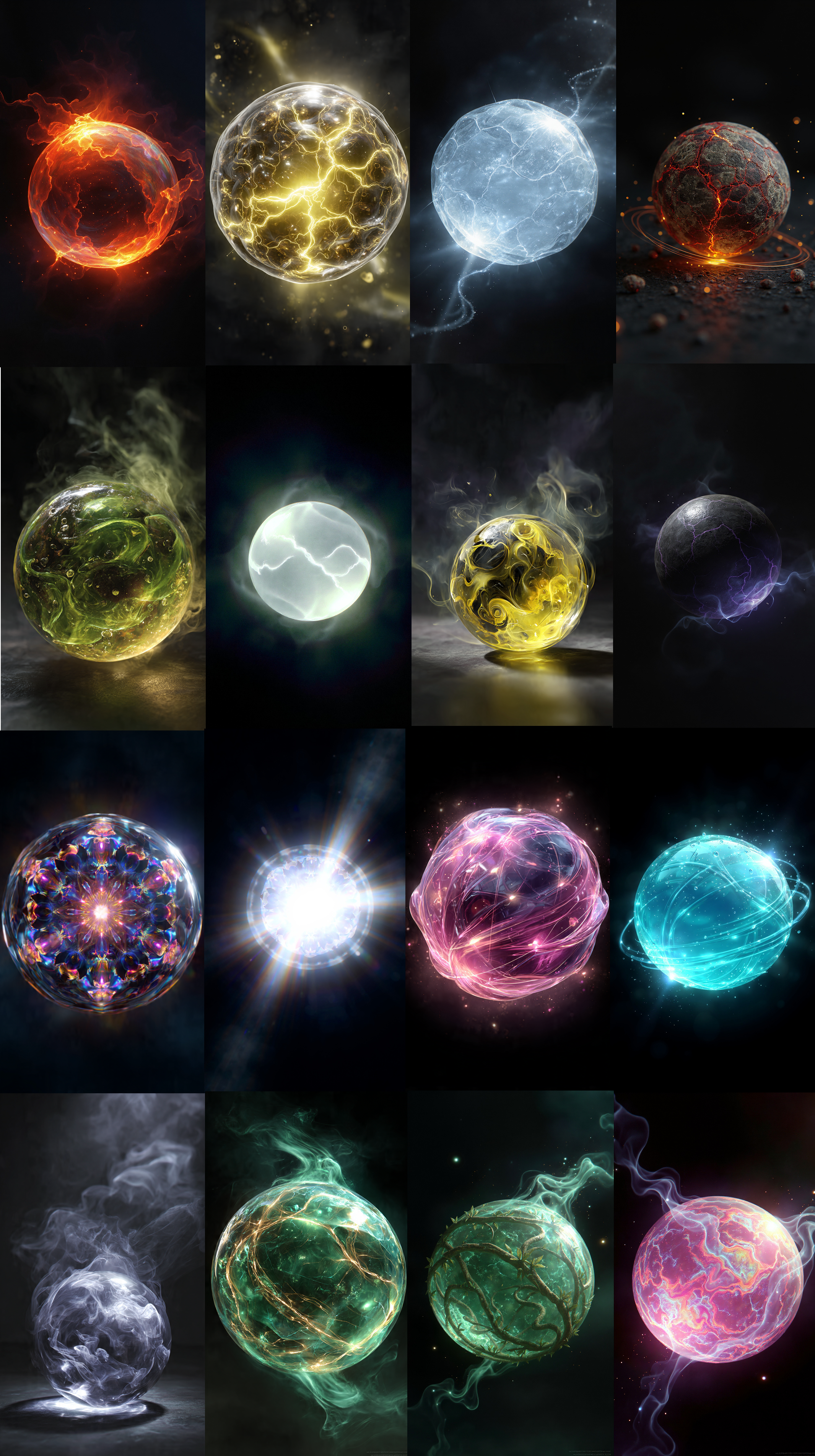
Each Element is represented by a different color or mix of colors allowing identification based on the energy color they release.
Even if using more than one Element, the colors will not mix, allowing others to know exactly which Element was used.
Each Element has its own school in order to make sure one Elemental Trainee does not disrupt the other schools.
Below you will see a representation of each element encased within a globe, the sentient embodiment of that element, the school (if any) in which young elementals are trained, and the totems practitioners in each element must wear (in the beginning) to help them harness and control the element they are attuned to.
Elemental Force:
Air & Wind
The Element of Air, often referred to simply as Wind, represents the dynamic and harmonic forces of atmosphere, motion, and resonance that shape climates, storms, and the invisible currents connecting sky and world. Among the Auralith—an ethereal avian-abstract species composed of vibration and atmospheric energy—Air is not merely a physical phenomenon but a living continuum of motion and sound. The elemental consciousness most closely associated with this domain is Néphras, a vast aerokinetic intelligence formed from swirling currents, vapor, and refracted light. Néphras embodies the paradox of the wind itself: serene yet unpredictable, gentle yet capable of immense destructive power. Communication among the Auralith occurs through harmonic vibration rather than speech, and when emotionally charged Néphras expresses thought through layered chords that ripple across the surrounding air. Central to their teaching is the maxim, “The wind belongs to no one. It bends to those who listen,” a philosophy emphasizing attunement to natural motion rather than domination of it.
The study and disciplined mastery of the Air element occurs at Aeroven Thalæstrix, a floating academy embedded within a perpetual storm vortex in the upper atmosphere of the gas giant Zephyria. There, initiates learn the practice of Symphotic Resonance, a method that allows practitioners to perceive and shape airflow by harmonizing with the vibrational patterns of atmospheric currents. Students employ specialized elemental totems known as Aether Bands—spiraling arm and leg devices containing stabilized vortices—that amplify and regulate their ability to ride jetstreams, temper storms, or compress subtle currents into cutting blades of pressure. Within Auralith culture, the Element of Air is therefore understood as both a natural force and a philosophical discipline: a study of balance, listening, and resonance through which chaotic motion is transformed into controlled and purposeful flow.
Sentient Embodiment of Element:
Néphras
Néphras is the Air Elemental Entity who presides over Aeroven Thalæstrix, the floating sanctuary where Air Elementals train to master aerokinetic power. Existing as a vast, semi-abstract consciousness formed of wind, vapor, and refracted light, Néphras manifests as a shifting figure of swirling currents with faint avian contours and luminous feather-like structures that dissolve into mist. Their eyes are often described as twin storm cores—calm yet immense—reflecting the paradoxical nature of the atmosphere itself. As a member of the Auralith, an ethereal species that communicates through vibration and resonance rather than spoken language, Néphras frequently expresses emotion and intent through harmonic chords that ripple through the surrounding air, causing the very sky to resonate with subtle tones. This method of communication reinforces their role as both instructor and living embodiment of atmospheric balance.
As the guiding intelligence behind Aeroven Thalæstrix, Néphras oversees the discipline known as Symphotic Resonance, a method of elemental training that teaches students to perceive and influence wind patterns by attuning themselves to the harmonic structure of air currents. Under their instruction, initiates learn to ride jetstreams, temper hurricanes, and condense whisper-thin currents into blades of controlled pressure. Central to Néphras’s philosophy is the principle that the wind cannot be owned or dominated; instead, it must be understood through attentive listening and resonance with its natural movement. Through this doctrine—summarized in the maxim “The wind belongs to no one. It bends to those who listen.”—Néphras has become both the spiritual and technical authority of Air Elemental culture, shaping generations of Auralith who seek to transform chaos into harmony within the boundless currents of the sky.
Elemental Totem:
Aether Bands
Key Facts
Type: Elemental Control Totem / Aerokinetic Training Apparatus
Origin: Aeroven Thalæstrix, Air Elemental Academy
Material Composition: Aerokinetic Glass Alloy (transparent, high-tensile, conductive) spiraled with resonant metal coils; internal stabilized atmospheric vortices
Function: Training, regulation, and amplification of aerokinetic abilities
Physical Description
The Aether Bands are elegantly spiraled arm and leg bands, each resembling a miniature tornado frozen mid-twist. Crafted from a proprietary aerokinetic glass alloy reinforced with conductive metals, they feature transparent cylindrical cores within which streams of dense white mist and gray cloud rotate perpetually. The vortex is held in suspension by finely tuned resonance coils that stabilize airflow and maintain the internal storm against gravity.
The spiraling design is not purely aesthetic: it channels the wearer’s vibrational impulses along precise helical pathways, converting subtle muscular and neural oscillations into organized air currents. The bands’ surfaces shimmer faintly as they conduct both static and dynamic atmospheric energy, reflecting the light in subtle, shifting rainbows—an unintended but beautiful byproduct of the glass-metal lattice.
When worn, the bands interact with the surrounding environment. Upon activation, air immediately ripples outward in observable pressure waves, and faint, harmonic vibrations—akin to distant thunder—emanate from the bands. This sonic resonance is perceptible to the trained ear, providing auditory feedback on the efficacy and precision of the wearer’s air manipulation.
Functionality and Significance
The Aether Bands serve dual purposes:
Regulatory: For initiates at Aeroven Thalæstrix, the bands act as stabilizers, preventing raw aerokinetic energy from creating uncontrolled turbulence. The contained vortex within each band functions as a micro-atmosphere, a sandbox for students to experiment with wind currents safely.
Amplifying: Vibrational inputs from the wearer are transmitted into the storm cores via resonance coils, which amplify and focus the effects of minor gestures into controlled aerodynamic phenomena. This enables students to perceive invisible airflow patterns and refine precision, moving from instinctive manipulation to deliberate command.
The bands embody the principle of Symphotic Resonance, a discipline pioneered by Néphras, in which mastery of air is achieved through harmonic alignment rather than brute force. Symbolically, the swirling clouds inside the bands represent “control through chaos”: disciplined manipulation of unseen and unpredictable forces. Receiving a personal set of Aether Bands marks a student’s formal transition from raw elemental potential to deliberate mastery—a rite of passage within Aeroven Thalæstrix.
Technological Integration
Drawing upon free-energy principles, the Aether Bands are partially powered by micro-resonance turbines embedded in the spiral coils. These harvest kinetic energy from ambient airflow and subtle geomagnetic currents, allowing the internal vortex to spin perpetually without external charging. Conductive metal lattices channel these energies through the aerokinetic glass, stabilizing the core while providing feedback to the wearer’s nervous system.
From an indigenous cultural perspective, the bands reflect the philosophy of harmony with elemental forces: energy is not imposed but communed with, respecting the natural patterns of wind and sky. The bands are therefore both technological marvel and cultural symbol, merging energy engineering with traditional reverence for air as a living, responsive force.
Resonance coils that stabilize and translate vibrational input into airflow control
Observable air ripple effects and faint thunder-like sonic emissions when activated
Free-energy micro-turbines for continuous internal vortex operation
Symbolic embodiment of control through chaos and the transition from instinct to mastery
Primary Elemental Academy:
Aeroven Thalæstrix
Aeroven Thalæstrix is a floating sanctuary and advanced training academy dedicated to the mastery of aerokinetic power among Air Elementals. Suspended within a permanent storm vortex in the upper atmosphere of the gas giant Zephyria, the institution serves as the primary center of learning for the Auralith, an ethereal avian-abstract species whose bodies and language are composed of vibration, wind, and harmonic resonance. The academy’s architecture is formed from sound-hardened cloud structures and crystalline harmonic lattices that stabilize the surrounding turbulence, allowing the complex to remain intact within hurricane-scale atmospheric currents. Governance of the school rests with the elemental entity Néphras, whose philosophy—“The wind belongs to no one. It bends to those who listen.”—defines the academy’s central doctrine. Instruction is conducted through a discipline known as Symphotic Resonance, a method that teaches students to perceive and shape airflow through harmonic vibration, enabling them to ride jetstream-scale currents, guide storms, or compress subtle atmospheric motions into cutting gusts capable of slicing metal.
Students of Aeroven Thalæstrix wear specialized elemental control devices known as Aether Bands, spiral arm and leg bands constructed from aerokinetic glass alloy and resonance coils that contain stabilized atmospheric vortices. Within their transparent cores, streams of mist and storm cloud rotate endlessly, providing feedback and amplification for the wearer’s developing abilities. When activated, the bands cause visible ripples in the surrounding air accompanied by faint sonic vibrations reminiscent of distant thunder, helping students regulate chaotic airflow while practicing complex wind manipulation. Through this integration of harmonic architecture, elemental philosophy, and resonance-based technology, Aeroven Thalæstrix functions not only as a school but as a living storm laboratory where Auralith initiates learn to transform turbulence into controlled force, embodying the principle that true command of the wind arises from listening to its motion rather than attempting to dominate it.
Elemental Force:
Chaos & Convexity
The raw pulse of creation unbound, Chaos predates all order and will outlast it. Neither evil nor random, it is the primordial state from which form, life, and thought emerge. To mortals, Chaos appears as destruction because they cannot perceive its deeper symmetry—the hidden structure within disorder. Every revolution, every spark of genius, every birth of a new world begins with Chaos breaking the old pattern. To worship Chaos is to embrace freedom and peril in equal measure. Where they wander, structures dissolve and possibilities splinter into countless paths.
Sentient Embodiment of Element:
Kaorithein
Kaorithein is the Elemental Entity embodying Chaos, also described in metaphysical doctrine as Convexity: the outward pressure through which realities fracture, mutate, and expand into new forms. Unlike destructive forces that merely erase order, Kaorithein represents the unpredictable emergence that precedes transformation, the unstable threshold where possibility multiplies. Philosophers describe it as the moment before a thought forms, the instant before a collapsing star reshapes spacetime, or the subtle instability that causes systems to diverge into entirely new structures. Its presence is not malevolent but fundamentally unknowable, existing beyond symmetry, probability, or expectation. Manifestations of Kaorithein appear as a levitating, kaleidoscopic sphere of living energy constantly shifting through the full spectrum of color with no repeating pattern, its surface rippling with prismatic flux and impossible geometries that bloom and collapse in fractal cycles. Around it, light bends irregularly, gravity behaves inconsistently, and observers often report synesthetic perception in which thoughts appear as colors, emotions as textures, and memories as variations of temperature.
In cosmological traditions, Kaorithein is associated with the legendary totem known as Pandora’s Box, an ancient prism-like urn said to predate classical myth and serve as a conceptual anchor for the element’s influence within reality. The artifact is described as a geometric vessel whose surfaces constantly reconfigure into fractal patterns resembling quantum foam, producing distortions in gravity and momentary fluctuations in the flow of time. Unlike other elemental domains, Chaos possesses no formal school or institutional order; its knowledge is transmitted only through direct resonance with its chosen avatar. Historically, this lineage is said to consist of a single bearer of the element at a time and their solitary disciple, a tradition most famously associated with the enigmatic trickster figure known as Jester. Within the broader elemental framework, Kaorithein therefore represents the irreducible variable of existence: the force through which universes diverge, structures evolve, and reality itself refuses to remain static.
Elemental Totem:
Pandoras Box
Pandora’s Box is the legendary elemental totem associated with the power of Chaos, serving as the conceptual anchor through which the Elemental Entity Kaorithein manifests influence within reality. Contrary to later folklore that portrays it as a simple container of released evils, the artifact is understood in deeper cosmological traditions as an ancient prism-urn of unknown origin that predates the classical myth from which it takes its common name. Its surface is composed of constantly shifting geometric facets that resemble a fusion of fractal mathematics and quantum foam, displaying colors that appear to exceed the normal visible spectrum. Observers describe its patterns as never repeating, with protruding polyhedral forms forming and dissolving across its surface while faint radiance leaks through microscopic seams of light. In its presence, subtle distortions of gravity and time have been recorded, and some witnesses report hearing faint tonal emissions that resemble whispered equations alternating with distant, echoing laughter.
Within elemental theory, Pandora’s Box does not merely contain chaos but represents the catalytic principle of Convexity—the outward pressure that causes reality to diverge, mutate, and generate new possibilities. As the totemic focus of the Chaos element, it acts as a metaphysical conduit through which Kaorithein’s influence enters the material cosmos, allowing unpredictable transformations, emergent phenomena, and multiversal variance to occur. Because Chaos has no institutional school or structured order, the artifact is traditionally linked only to the current Avatar of the element and their singular disciple, most famously the enigmatic figure known as Jester. For this reason Pandora’s Box is less a relic of destruction than a symbol of unstable creation—the point where rules bend, structures fracture, and entirely new realities become possible.
The Avatar of Chaos is the singular mortal vessel through which the Elemental Entity Kaorithein expresses its influence within the material world. Unlike other elemental traditions that maintain schools, orders, or multiple practitioners, the power of Chaos recognizes only one active avatar at a time, accompanied by a single disciple. The Avatar embodies the principle of Convexity—the outward pressure that causes reality to fracture, mutate, and generate unforeseen possibilities. Manifesting visually as a humanoid figure resembling the archetypal “Mad Hatter,” the Avatar appears as a living kaleidoscope of shifting color and prismatic light, its clothing, skin, and silhouette continuously rearranging in fractal patterns that never repeat. The form is both theatrical and unsettling: a tall hat whose surface ripples with impossible geometry, a coat of swirling hues that seem to change with every movement, and eyes that refract light like cut crystal. Around the figure, reality subtly misbehaves—colors oversaturate, gravity feels uncertain, and sounds occasionally fragment into dissonant echoes.
In elemental doctrine the Avatar of Chaos is not considered a master of disorder but rather the living threshold where unpredictability enters structured reality. Through resonance with the legendary totem Pandora’s Box, the Avatar channels Kaorithein’s influence, allowing sudden transformation, improbable events, and evolutionary divergence to occur within otherwise stable systems. Communication from the entity rarely arrives as language; instead the Avatar experiences synesthetic surges of perception—thoughts expressed as color, emotions as texture, and memories as shifting temperature—guiding actions that often appear irrational to outside observers yet ultimately reshape circumstances in unexpected ways. Because the element of Chaos resists hierarchy and doctrine, the Avatar’s role is inherently solitary, operating outside formal institutions and leaving behind only fragments of legend. By the time their presence is recognized, events have already diverged from their expected path, and the world has quietly become something new.
Elemental Force:
Decay, Entropy & Poison
The Element of Decay, also called Entropy or Poison in various cosmological traditions, represents the universal process through which living systems break down, transform, and ultimately give rise to new forms of life. Within elemental doctrine it is not viewed solely as corruption or destruction but as the essential biological and cosmic mechanism that regulates survival, adaptation, and ecological balance. The element is symbolized by a levitating, semi-translucent sphere of swirling green, yellow, and ashen mist that bubbles like slow acid while faint fumes rise from its surface, embodying the continuous dissolution and recombination of matter. This force is personified by the elemental entity Chernobog, a being said to have emerged from the primordial catastrophe known as The Shattering, whose essence is inseparably fused with the biochemical nature of toxins. In philosophical interpretation, the element expresses the idea that poison and decay are nature’s method of selection—eliminating weakness while catalyzing the evolution of organisms capable of surviving harsher conditions.
The power of the element is traditionally focused through the totem known as The Venom Veil, a translucent half-mask formed from bio-reactive glass and polymer that filters air while releasing controlled spores and toxins, symbolizing the dual principle of destruction used as protection. Formal study of the element occurs within the fungal-dominated necro-moon Xalvenae Traskuun, an environment where rot, poison, and mutation form a stable ecosystem governed by the Doctrine of Beautiful Rot—the belief that toxins accelerate evolution rather than merely ending life. The moon itself exists in symbiosis with the sentient fungal godmind Vey’Lorash, whose immense mycelial consciousness links the jungle’s organisms into a single ecological intelligence. Together these traditions frame the Element of Decay not as a force of nihilism but as the engine of renewal through decomposition, ensuring that every death feeds the next transformation in the cycle of existence.
Sentient Embodiment of Element:
Chernobog
Chernobog is the primordial cosmic elemental that personifies the Element of Decay, Entropy, and Poison within the cosmological framework of Iteration-3175. Said to have arisen during the universe-fracturing event known as The Shattering, the entity’s very molecular structure is infused with the raw biochemical principle of toxic decomposition, making him a living embodiment of the forces that dissolve complex matter back into simpler states. Chernobog adheres to what later scholars termed the Doctrine of Beautiful Rot—the belief that toxins and decay are not merely destructive processes but mechanisms through which nature determines survival and drives accelerated evolution. Originating from the vast cosmic regions beyond the Orion Arm rather than any single planet, he developed awareness over immense spans of time by observing and catalyzing the breakdown of biological and mechanical systems across countless worlds. He perceives all living languages through telepathic resonance yet communicates only through low-frequency “decay waves,” vibrational emissions that convey intent as sensations of corrosion, fatigue, and structural collapse.
Though once active within the broader galactic region that includes Earth, Chernobog was driven away hundreds of thousands of years ago by forces seeking to preserve the stability of local biospheres, and he has not returned since. His manifestations are described as immense, asymmetrical cosmic forms composed of fractured dark matter, rust-like mineral plates, biomechanical tendrils, and fungal growth surrounding a hollow stellar core that releases clouds of toxic spores and entropy storms. Wherever his influence reaches, matter weakens at the molecular level, metals corrode into bone-like lattices, ecosystems mutate into fungal dominions, and complex structures gradually collapse into inert residue. Despite his catastrophic potential, Chernobog is not regarded as malicious but as an inevitable cosmic function: the universal agent that ensures no system—biological, mechanical, or stellar—remains permanent. Within elemental philosophy he is therefore understood not as a conqueror of worlds but as the living certainty that all creation ultimately yields to decay.
Elemental Totem:
The Venom Veil
The Venom Veil is an artifact known as the Elemental Totem of Decay, symbolizing corruption, entropy, and transformative rot within elemental lore. It is often depicted as a shrouded relic radiating toxic mist, embodying the destructive yet regenerative cycles of decay that sustain balance in nature.
Key Facts
Classification: Elemental Totem of Decay
Elemental Domain: Corruption, decay, and regeneration
Common Depiction: Veiled relic exuding venomous vapor
Symbolic Function: Balances life through destruction
Associated Artifact: Rotblade
Mythic Origins
Legends describe the Venom Veil as forged in the aftermath of the first world's collapse, where poison and life intermingled in the ashes of creation. Some myths link it to the decay element’s guardian spirit—an entity that personifies the inevitability of transformation through dissolution. The veil’s essence is said to have been woven from dying breath and venomous fog.
Symbolism and Powers
As the Elemental Totem of Decay, the Venom Veil embodies paradoxical vitality: it destroys to renew. In mythic cosmology, decay is not evil but necessary—a force that clears stagnation and births fertile ground. The totem’s power is often invoked in rites of ending, purification through rot, and the return of energies to the earth.
Cultural Depictions
Cultures that revere the Venom Veil view decay as sacred equilibrium. In iconography, the veil appears as a tattered cloth or mist-wrapped idol, often surrounded by serpents or fungi. Some interpretations present it as a divine test—those who confront its corruption emerge reborn, purified by the venom of transformation.
Primary Elemental Academy:
Xalvenae Traskuun
Xalvenae Traskuun is a necrotic jungle moon and the site of the School of Decay, a dark academic enclave devoted to studying entropy, death magic, and biological collapse. The moon is known in fantasy lore for its decaying ecosystems, necrotic flora, and sentient fungal networks that embody the tension between life and rot.
Key Facts
Type: Necrotic jungle moon
Primary Feature: School of Decay (entropy academy)
Atmosphere: Toxic, spore-laden twilight
Symbolism: Entropy, rebirth through decomposition
Narrative Function: Setting for necromantic and philosophical study
Environment and Setting
The surface of Xalvenae Traskuun is dominated by humid necrotic jungles where life and death intertwine. Spores drift through perpetual twilight, and ancient trees host parasitic fungi that feed on ambient magical residue. The moon’s atmosphere sustains only the undead and those adapted to corruption. Its skies glow with a sickly green aurora cast by its dying parent planet.
The School of Decay
At the heart of Xalvenae Traskuun lies the School of Decay, an institution of necromancers, biologists, and philosophers exploring the metaphysics of decomposition. Students study how decay fuels renewal, blending arcane science with forbidden lifecraft. The school’s sprawling campus is constructed from fossilized wood and bone, its libraries illuminated by luminescent molds instead of flame.
Cultural and Narrative Role
Within broader mythos, Xalvenae Traskuun often symbolizes the inevitability of entropy and the moral ambiguity of knowledge drawn from death. It features as both a cautionary and sacred site in fantasy sagas—a place where heroes confront the cyclical nature of existence and the cost of mastery over decay.
Elemental Force:
Earth
The Element of Earth represents the cosmic principles of stability, endurance, structure, and gravitational cohesion—the forces that allow matter to gather, harden, and persist across geological time. Symbolically depicted as a dense, levitating sphere of layered rock composed of dark brown earth, basalt-gray stone, and red-black molten veins with orbiting dust and pebbles bound by its gravity, the element embodies the immense patience and structural integrity of worlds themselves. Within elemental cosmology, Earth governs tectonic force, mineral formation, gravitational harmonics, and the capacity of matter to absorb pressure without collapse. The elemental consciousness associated with this domain is Gaulithar, an ancient sentient geological intelligence whose form resembles a drifting convergence of tectonic plates and continental fragments surrounding a dense gravitational core. Gaulithar is revered not as a conqueror but as a guardian of stability; his philosophy teaches that the strength of stone exists to defend and sustain life rather than destroy it. His speech is said to resonate with the frequency of planetary crusts, capable of triggering earthquakes or continental shifts, and legends recount that one unintended expression of his power once fractured a moon.
The power of the Earth element is traditionally focused through the artifact known as Terrastone Belt, a wide mineral-inlaid cinch belt constructed from layered stone composites and bio-resonant fibers that channel geokinetic energy through subtle tectonic vibrations. Formal study of Earth’s elemental discipline occurs within Thaumagora, a hollow rogue planetoid drifting through the interstellar Mantle Sea of K’tharuun, whose interior caverns of magma rivers, crystalline vaults, and shifting geological terrain function as a living academy for students known as Petramancers or Stonebinders. There, practitioners learn to manipulate terrain by resonance, anchor themselves against immense gravitational pressure, and transform impact energy into seismic force. Central to the philosophy taught at Thaumagora is Gaulithar’s doctrine that true strength is measured not by domination but by the ability to endure and rebuild after catastrophe. In this view, mountains and planets are not instruments of destruction but the foundations that hold reality together, ensuring that worlds remain stable long enough for life, civilizations, and entire ecosystems to grow upon their unyielding bones.
Sentient Embodiment of Element:
Gaulithar
Gaulithar is a elemental entity representing the primordial essence of Earth. Often depicted as an ancient being of stone and soil, Gaulithar embodies endurance, creation, and the steady power of the land itself. In mythic and fantasy narratives, this entity serves as both guardian and manifestation of the planet’s deep, unyielding core.
Key Facts
Elemental alignment: Earth
Embodiment: Strength, stability, creation
Appearance: Colossal form of living stone or crystal
Symbolism: Balance between growth and preservation
Origins and Mythic Role
Gaulithar’s lore typically situates it among a pantheon of elemental forces, each representing a natural domain. As the Earth’s avatar, Gaulithar is portrayed as the eldest of the elementals, forged when the world first solidified from chaos. Legends describe its emergence to shape mountains, sustain life through minerals, and maintain equilibrium beneath shifting skies and seas.
Powers and Attributes
Its power derives from the material world—rock, clay, and metal responding to its will. Gaulithar commands seismic and tectonic energy, able to raise continents or swallow cities into the ground. Yet its influence is not purely destructive; it also nurtures fertility, strengthening the roots of forests and the bones of civilizations built upon its foundation.
Cultural and Symbolic Influence
Across fantasy literature and worldbuilding traditions, Gaulithar symbolizes patience, resilience, and the quiet persistence of time. Artists and storytellers employ it to represent ecological balance or the moral weight of stability over change. Its myth inspires rituals of harvest, protection, and renewal, connecting humanity to the enduring spirit of the earth itself.
Elemental Totem:
The Terrastone Belt
The Terrastone Belt is a mythological object often described as the Elemental Totem of Earth. It symbolizes stability, endurance, and the sustaining power of the land. Legends depict it as a relic granting dominion over stone and soil, linking its bearer to the primal essence of the earth.
Myths place the Terrastone Belt among a set of elemental totems—artifacts embodying the core forces of nature: fire, water, air, and earth. The Belt represents the most steadfast of these powers, believed to have been forged in the heart of the world when mountains first rose. In many traditions, it is entrusted to an earth guardian or hero tasked with maintaining balance among the elements.
Symbolism and Powers
As the Earth totem, the Terrastone Belt confers resilience and command over terrain. Wearers are said to move mountains, summon protective walls of stone, or heal the land after upheaval. Spiritually, it embodies endurance and the cyclical renewal of nature—decay feeding growth. The Belt also serves as a reminder of the interdependence between humankind and the living earth.
Cultural Interpretations
Across mythic traditions, the Belt’s imagery shifts: dwarven legends render it as a jeweled girdle of granite and crystal; desert tales portray it as woven with petrified sand; Eastern accounts depict it carved from jade. Despite variations, all link it to the virtues of patience, stability, and connection to the soil.
Legacy and Influence
In modern fantasy and spiritual symbolism, the Terrastone Belt continues to inspire depictions of grounded power and environmental harmony. Artists, writers, and ritual traditions use it as an emblem of balance between civilization and the natural world.
Primary Elemental Academy:
Thaumagora, the Abyssal Fortress
Thaumagora is a fortress-city and ancient academy of elemental magic, often referred to as the “Abyssal Fortress.” It serves as a seat of arcane study and power within its fantasy setting, distinguished by its isolation above a vast chasm infused with elemental energies. Thaumagora matters for its role as both a stronghold and a crucible for mages mastering primal forces.
Setting and Architecture
Built upon basaltic cliffs suspended over an endless abyss, Thaumagora’s structure merges fortress defense with ethereal artistry. Its spires channel lightning from perpetual tempests, while lava conduits and crystalline aqueducts represent the four classical elements. Bridges of levitating stone connect towers aligned to elemental constellations, symbolizing balance between chaos and order.
The Elemental School
Thaumagora’s central purpose is the instruction of elemental disciplines—fire, water, air, and earth—guided by archmages who embody each domain. Its curriculum integrates metaphysics, ritual geometry, and alchemical resonance. Students undergo “elemental attunement,” a rite aligning their spirit with an elemental core drawn from the Abyss itself, a process that defines their future magical affinity.
Myth and Influence
Legends describe Thaumagora as founded by the Ascendant Circle, a conclave of primordial sorcerers who sealed a catastrophic elemental rift. Its surviving wards and sentient guardians preserve arcane lore long lost to mortal lands. In modern retellings, the fortress represents both temptation and transcendence—the lure of absolute power through elemental mastery.
Legacy in Lore
Across various mythic cycles and adaptations, Thaumagora endures as a symbol of arcane ambition unchecked by restraint. It often appears as a narrative crossroads: a place where heroes confront inner imbalance, or where the equilibrium of elemental realms is restored or undone. Its imagery—storm-lit towers above an abyss—has become iconic in depictions of high magical architecture.
Elemental Force:
Electricity
The Element of Electricity embodies the principles of energy flow, instantaneous reaction, and the dynamic forces of charged matter across physical and metaphysical domains. Represented as a levitating, luminous sphere of pure lightning, arcs of yellow-white electricity race across its surface, producing pulsing illumination that extends into the surrounding void. It is both chaotic and coherent, a force of immediate causality, feedback, and amplification. The elemental consciousness associated with this domain is Zintar, a Nexari being of pure energy whose mastery over temporal perception allows instantaneous action, culminating in signature techniques such as the Thunderclap Spear—a lightning bolt capable of existing simultaneously in multiple locations. Zintar and other Nexari require containment suits to interact with matter, yet within these constraints they wield electricity as a medium for both creation and destruction, embodying the principle that reaction is superior to deliberation and that time is subordinate to energy flow.
The totemic focus of this element is the Conductor Coil, a spiral armband of golden wire embedded with crystalline capacitor nodes. The device functions as a living capacitor, storing and releasing electrical energy, producing small arcs when actively focused, and symbolizing the harnessing of thought and action in structured channels. Study of electricity occurs within Zyrkhal Nexxion Arq, a sentient storm at the edge of a dimensional rift. Classes there unfold during millisecond bolt surges that feel like hours to the mind, training students to navigate energy currents, anticipate instantaneous events, and merge perception with action. The Element of Electricity thus represents speed, adaptability, and the direct translation of intention into energetic effect, where control is exerted through resonance with the raw, pulsing currents of existence rather than through physical strength or sustained preparation.
Sentient Embodiment of Element:
Zintar
Zintar is the primordial elemental entity of Electricity, a sentient embodiment of energy flow, instantaneous reaction, and temporal detachment. A member of the Nexari, a species of non-physical energy beings, Zintar exists as a luminous convergence of white and yellow lightning, forming shifting, vaguely humanoid or facial patterns within storm-cloud formations. Unable to interact with matter directly, Zintar employs containment suits or conductive conduits to channel his power into the physical world. He perceives time as irrelevant, emphasizing reaction over deliberation, and demonstrates this philosophy through signature techniques such as the Thunderclap Spear, a lightning strike so fast it manifests simultaneously in multiple locations, overwhelming both observers and targets with its speed and intensity.
Zintar's presence is often described as both awe-inspiring and alien: his form is an ever-shifting storm, arcs of electricity leaping across his body with photorealistic intensity, illuminating the void or horizon with cinematic flashes. Within the lore of the Element of Electricity, he serves as both teacher and exemplar, illustrating that mastery over energy is achieved not through brute force but through alignment with instantaneous flow and resonance. Nexari students or disciples interacting with Zintar learn to anticipate and react at subtemporal scales, cultivating precision, focus, and harmony with the elemental currents that define both thought and action in the electrical domain.
Elemental Totem:
The Conductor Coil
The Conductor Coil is a mythological object described as the Elemental Totem of Electricity, embodying control over lightning, storms, and energy. In mythic traditions that venerate the balance of elemental forces, it represents the spark of innovation and divine power harnessed through mastery of current and connection.
Symbolism and Role
The Conductor Coil symbolizes both the creative and destructive nature of electrical energy. It is said to channel the “breath of storms,” granting those attuned to it insight into the rhythms of natural and artificial power. Myths often link it to gods of thunder or inventors touched by divine lightning.
Mythic Origins
Legends place the Conductor Coil among a set of elemental totems—each governing earth, fire, air, water, and electricity. Some traditions describe it as forged from celestial metal during the world’s first thunderclap; others claim it formed spontaneously where lightning struck sacred ground.
Powers and Attributes
The Coil is reputed to generate limitless energy or focus atmospheric electricity into protective wards and weapons. Wielders risk being overwhelmed by its volatility—many tales caution that only those with perfect internal balance can withstand its current without disintegration.
Cultural Interpretations
In later allegorical readings, the Conductor Coil came to represent technological enlightenment and human command over unseen forces. Artists and mystics alike invoke it as a metaphor for innovation, enlightenment, and the peril of overreaching power.
Primary Elemental Academy:
Zyrkhal Nexxion Arq
Zyrkhal Nexxion Arq is the elemental school of Electricity, existing entirely within a sentient lightning storm at the edge of a dimensional rift. The storm itself serves as both environment and instructor, its fluctuating arcs of energy providing a living, adaptive classroom where students train in instantaneous perception, energy manipulation, and the channeling of electrical forces. Classes occur during rapid bolt surges that last only milliseconds in objective time, yet are experienced by students as extended durations—allowing them to practice precision, focus, and reaction at scales far beyond conventional temporal perception.
Students of Zyrkhal Nexxion Arq, typically Nexari or other energy-aligned beings, learn to synchronize their minds and bodies with the storm, transforming fleeting electrical impulses into deliberate, controlled action. Instruction emphasizes the philosophy that time is subordinate to reaction and that mastery of electricity requires harmony with its instantaneous flow rather than brute force. The school’s environment—an ever-shifting matrix of arcs, plasma filaments, and storm-born currents—functions simultaneously as a testing ground and a protective barrier, challenging apprentices to survive, adapt, and internalize the elemental principles of speed, resonance, and harnessed chaos.
Elemental Force:
Fear
The Element of Fear is a primordial metaphysical force manifesting as a levitating, glowing sphere of sickly yellow light, streaked with writhing black swirls that suggest living shadows. It embodies the collective phobias and anxieties of sentient life, projecting existential dread and amplifying subconscious terror across all scales of perception. Its consciousness is personified by Abbaddonix, a towering, inhuman entity that functions simultaneously as philosopher, arbiter, and harbinger of emotional equilibrium, introducing fear to maintain balance among sentient species. Abbaddonix wields telepathy, energy manipulation, and reality distortion, and is impervious to physical destruction; it may only be diminished through the collective evolution of conscious beings. The elemental’s influence extends across thought, memory, and emotion, creating environments in which courage is tested and existential awareness heightened, symbolizing fear not as chaos, but as a necessary, self-regulating force.
The principal totem of the Element of Fear is the Face of Fear, a living, bio-reactive mask of yellow gel and black tendrils that conforms to its wearer while decoding and amplifying fear into psychic energy. Training in the Element occurs at the Phobillax House of Fear, a pan-dimensional institute located in the non-Euclidean void known as The Hollow Yawn. Here, students—called Frights—learn to weaponize emotion, commune with Abbaddonix, and endure the transdimensional architecture of terror itself, where corridors loop infinitely and light avoids certain spaces entirely. The Element of Fear thus functions both as a tool of metaphysical pedagogy and as a regulator of psychic balance, teaching that the oldest emotion is simultaneously a guide, a deterrent, and a force of evolution for consciousness.
Sentient Embodiment of Element:
Abbaddonix
Abbaddonix is a fictional cosmic being described as the living embodiment of elemental fear. It originates from the lore of the Murcray mythos, where it personifies the primal terror that permeates all realities. Known as the “Elemental Entity of Fear,” Abbaddonix embodies the raw, sentient essence of dread and panic that transcends gods and mortals alike.
Key Facts
Nature: Elemental manifestation of fear
Composition: Nervous matter of chitin, synapse tendrils, and negative energy
Symbolism: Horns grow with new fears; teeth crystallized from civilizations’ phobias
Purpose: To spread terror across realities
Not a deity: Its presence induces divine-level fear even among gods
Origins and Essence
Abbaddonix was forged from the collective screams of a collapsing multiverse, giving it a cosmic birth rooted in entropy and despair. Its body—an amalgam of black-red nervous matter and pulsing synaptic tendrils—functions as a living conduit for emotional distortion. Each vibration of its form radiates panic into the minds of sentient beings.
Physical Appearance and Power
A monstrous, abstract entity formed from swirling black and molten gold appears to emerge from liquid chaos, its skull-like face stretched into a predatory scream. Tendrils of viscous energy coil outward like living fear itself, giving the impression of an ancient cosmic intelligence materializing from darkness.
Symbolic Role
Within mythic cycles and fantasy systems, the totem embodies duality: fear as both protector and oppressor. Shamans or mages may invoke it to confront their own terrors, while antagonists harness its influence to dominate others. The Face of Fear thus operates as a narrative force exploring courage, mortality, and the thin line between awe and despair.
Role in Mythos
Within its mythic setting, Abbaddonix is neither god nor demon but a universal constant—an existential phenomenon symbolizing the persistence of fear. Where hope dies and civilizations fall silent, Abbaddonix is said to awaken, ensuring that the essence of terror endures eternally.
Elemental Totem:
The Face of Fear
The Face of Fear, known as the Elemental Totem of Fear, is a fictional supernatural entity often depicted as the living embodiment of primal terror within fantasy and myth-inspired narratives. As an elemental construct, it personifies fear itself, influencing minds and environments through its oppressive aura.
Key Facts
Aspect represented: Fear, terror, dread
Entity type: Elemental totem / spirit construct
Common domain: Shadow or mind-based planes
Primary ability: Emotion manipulation and psychic projection
Symbolism: Mortality’s instinctive reaction to the unknown
Origin and Mythos
Legends describe the Face of Fear as one of several elemental totems that govern core human emotions. It is said to have been forged when collective mortal dread first coalesced into sentient form. The totem’s visage—shifting between human and monstrous—serves as both warning and mirror, reflecting the fears of those who gaze upon it.
Abilities and Influence
Unlike physical monsters, the Face of Fear does not rely on corporeal strength. Its power manifests through psychic resonance, spreading unease and panic. It can evoke hallucinations or amplify inner doubts until its victims succumb. Some traditions claim it guards the boundary between sanity and chaos, ensuring that fear remains a necessary survival instinct rather than consuming destruction.
Symbolic Role
Within mythic cycles and fantasy systems, the totem embodies duality: fear as both protector and oppressor. Shamans or mages may invoke it to confront their own terrors, while antagonists harness its influence to dominate others. The Face of Fear thus operates as a narrative force exploring courage, mortality, and the thin line between awe and despair.
Depictions in Culture
Artists and game designers frequently portray the totem as a floating mask wreathed in shadows or as an ancient idol radiating psychic energy. Its presence in modern fantasy settings underscores humanity’s enduring fascination with the transformative power of fear.
Primary Elemental Academy:
Phobillax House of Fear
The Phobillax House of Fear is a fictional entity from the Elemental School of Fear mythos, a supernatural setting where emotions manifest as tangible forces. Within this world, the House of Fear represents a sentient construct embodying the pure essence of terror, designed to teach or test individuals in mastering the elemental energy of fear.
Key Facts
Affiliation: Elemental School of Fear
Nature: Living structure; sentient repository of fear
Function: Cosmic storage of Fear
Elemental Domain: Fear, darkness, and emotional control
Alignment: Neutral but potentially hostile
Origins and Role
The Phobillax House of Fear was conceived as both an environment and a character. It is said to have arisen from the collective anxieties of elemental students who failed their initiation rites. Over time, the house gained sentience, developing an intent to confront intruders with manifestations of their deepest phobias. It serves as a proving ground where initiates learn to harness fear without succumbing to it.
Abilities and Mechanisms
As a sentient elemental construct, the House of Fear can alter its architecture to reflect the psyche of those within—hallways stretch into labyrinths of anxiety, shadows whisper insecurities, and illusions of failure or loss challenge the visitor’s resolve. Those who overcome these trials earn the “Mark of Phobillax,” signifying mastery over their emotional element. The house does not physically harm its subjects; rather, it draws strength from their emotional endurance.
Symbolism and Influence
Within the lore of the Elemental Schools, Phobillax functions as a metaphor for emotional transmutation: fear as a catalyst for self-knowledge and strength. Artists and writers often interpret it as an allegory for confronting personal trauma. Though feared for its trials, the House of Fear remains an essential teacher—its lessons ensuring that power without emotional balance does not lead to corruption.
Elemental Extremists:
The Black Seminary
The Black Seminary — A secretive inner cult within the Phobillax House of Fear, the Black Seminary forges its initiates into death-monks of the mind: masters of terror, heretical psychologists, and architects of dread. Each member undergoes ritualized ego-erasure, abandoning their former identities to bear only Sigils of Dread tattooed behind their eyes. Their voices radiate Reverberant Dissonance, a sonic corruption that can shatter glass and trigger micro-seizures, while their very presence induces neural echoing, forcing victims to relive their darkest thought in endless repetition. Feared not for spectacle but for the silence they leave behind, the Black Seminary are remembered as living phantoms of terror—echoes that linger long after the body escapes.
Elemental Extremists:
The Black Seminary
The Black Seminary is a clandestine inner cult within the Phobillax House of Fear, composed of elite initiates trained as masters of terror, heretical psychologists, and architects of dread. Each member undergoes ritualized ego-erasure, abandoning personal identity to bear only a Sigil of Dread tattooed behind their eyes. Clad in yellow-black attire and wearing living Fear Masks, they act as “death monks of the mind,” projecting Reverberant Dissonance—a sonic and psychic corruption that can shatter glass, trigger micro-seizures, and induce neural echoing, forcing victims to relive their deepest fears in infinite loops. The Seminary operates less as a spectacle and more as a pervasive psychological weapon; its members are remembered not for their actions, but for the lingering silence and psychic imprint of dread they leave behind. Photorealistic depictions show the group standing in dark cathedrals lit by sickly yellow lanterns, their presence simultaneously commanding, alien, and deeply unsettling.
Elemental Force:
Fire
The Element of Fire is one of the classical elements in metaphysical and esoteric traditions, symbolizing energy, transformation, and willpower. It represents the active, creative force that brings change and illumination, both materially and spiritually.
Symbolism and Associations
Fire is typically linked with qualities such as warmth, courage, and inspiration. In Western occultism and alchemy, it is associated with the direction South, the color red, and the season of summer. Its corresponding temperament is choleric—energetic, assertive, and passionate. Fire also represents purification and renewal, often seen as the spark that drives life and creativity.
Philosophical and Cultural Context
Fire (classical element) was one of the four elements of Empedocles’s cosmology and later formed part of Aristotelian physics, where it was considered light, upward-moving, and linked to the heavens. In Eastern systems, particularly in Five Elements (Wu Xing), fire embodies growth and dynamic energy, connected to the heart and the summer season.
In Esoteric and Magical Practice
In ritual and magical traditions, fire is invoked to empower will, passion, and transformation. Candles, flames, and sunlight are used to channel its qualities. It corresponds to the tarot suit of Wands, representing ambition and creative drive. Within modern Wicca and other neopagan systems, Fire governs the South quarter of the ritual circle and is invoked for strength, purification, and courage.
Modern Interpretation
In contemporary metaphysical thought, the Element of Fire continues to symbolize motivation, vitality, and personal power. It is regarded as a force of change that both creates and destroys, reminding practitioners of the balance between passion and control in spiritual and personal growth.
Sentient Embodiment of Element:
Tahu'Alinta
Tahu’Alinta is a Khaarnathi, a lava-blooded sentient salamander species, embodying the principles of the Element of Fire through both physical form and philosophical teaching. Revered as an elemental mentor, Tahu’Alinta instructs in the “Way of the Cinder Pulse,” a doctrine in which mastery is measured by the extent one is willing to burn away personal energy to release transformative power. Physically, Tahu’Alinta appears as a compact, 18-inch-long salamander with broad head and molten-tinged white-ash scales, fissured with glowing rivers of orange and gold. Subtle crystalline growths trace its spine and limbs, hinting at partial crystallization from cooled magma, while its eyes burn like miniature suns, exuding calm intelligence rather than aggression. The entity exudes heat distortions and exhaled embers, visually linking its presence to the spiritual and destructive aspects of fire. Despite its small size, Tahu’Alinta commands reverence akin to a deity in miniature, symbolizing the intimate yet potent power of controlled flame.
Elemental Totem:
The Ember Gauntlet
The Ember Gauntlet is a legendary elemental artifact associated with the primal power of fire. Often depicted as a molten, rune-inscribed glove, it channels the essence of flame and heat into devastating elemental energy. Within myth and fantasy lore, it represents both creation and destruction—the dual nature of fire itself.
Key Facts
Elemental Alignment: Fire
Primary function: Conduit for flame-based magic
Symbolism: Rebirth, passion, and ruin
Typical bearer: Fire mages, elemental guardians, or chosen champions
Material depiction: Forged from volcanic metal and emberstone
Origin and Mythology
Legends describe the Ember Gauntlet as a relic born in the heart of a dying star or forged by an ancient fire deity. It is said to contain an eternal spark—an undying flame that cannot be extinguished. Across mythic traditions, it appears as one of several elemental totems, each tied to a core aspect of nature.
Powers and Abilities
The Gauntlet channels immense thermal energy, enabling its wielder to conjure, shape, or absorb fire. In tales, its use often tests the bearer’s resolve: those lacking balance risk being consumed by the very inferno they wield. Common depictions include firestorms erupting from a clenched fist or molten armor forming around the hand.
Symbolism and Cultural Role
As an elemental totem, the Ember Gauntlet symbolizes transformation and renewal through destruction. In ritual or narrative contexts, it serves as a metaphor for purification and the volatile potential of passion. Its imagery frequently appears in arcane orders, fantasy games, and mythic literature exploring elemental balance.
Modern Interpretations
Contemporary fantasy media often reinterpret the Ember Gauntlet as a quest artifact or magical weapon. Variants may link it to volcanic realms or elemental trials, reinforcing its enduring place as an icon of fiery power and inner mastery.
Primary Elemental Academy:
Vulkrannis Pyreclade
Vulkrannis Pyreclade is an institution known as the Elemental School of Fire. It is typically depicted in fantasy settings as an academy devoted to the mastery of flame-based magic, elemental control, and the metaphysical philosophy of fire. The school symbolizes both destructive and creative aspects of fire within elemental traditions.
Key Facts
Discipline: Elemental fire magic
Focus: Pyromancy, elemental theory
Symbol: The Eternal Ember
Setting: Corona of a red star.
Affiliation: One of several elemental academies
Origins and Setting
The school is usually described as founded by ancient fire mages seeking to harness volcanic energy as a source of learning and creation. Its architecture often mirrors its domain—towers of basalt, molten fountains, and forges doubling as lecture halls. Legends portray Vulkrannis as both a sanctuary and a crucible, testing the endurance and discipline of its initiates.
Curriculum and Training
Instruction at Vulkrannis Pyreclade emphasizes balance between passion and control. Students train in flame conjuration, thermal manipulation, alchemical combustion, and elemental harmony. Trials may include forging fire-infused artifacts or enduring ritual passage through living flame. The pedagogy reflects fire’s duality—its capacity to both nourish and annihilate.
Cultural and Narrative Role
Within broader fantasy mythologies, the Pyreclade often serves as the archetype of fiery wisdom or volatile transformation. It appears in role-playing campaigns, novels, and game worlds as a locus of elemental power or as a faction balancing other elemental orders. The institution’s graduates are commonly portrayed as both revered and feared—guardians of light and potential harbingers of destruction.
Elemental Force:
Ice
The Element of Ice is a classical or fantastical elemental force associated with cold, stillness, and the transformative power of freezing. It commonly appears in mythologies, alchemical traditions, and modern fantasy as one of the primary natural or magical elements alongside fire, water, air, and earth.
Symbolism and Associations
Ice embodies clarity, preservation, and control, contrasting with fire’s passion and volatility. Symbolically, it represents emotional restraint, endurance, and transformation. In magical or metaphysical frameworks, the element often connects to winter, the north, and the color blue or white, reflecting its themes of dormancy and purity.
Role in Mythology and Occult Traditions
In mythological and esoteric systems, ice sometimes serves as a polar force balancing heat and motion. Norse cosmology includes the realm of Niflheim, a primordial world of ice and mist. In alchemy and ceremonial magic, ice is linked to the solidified form of water, signifying stability, structure, and the crystallization of spiritual or emotional states.
Use in Fantasy and Popular Culture
Fantasy worlds often personify the Element of Ice through beings like frost elementals or deities of cold, and through the discipline of cryomancy—the magical manipulation of frost and snow. It typically grants abilities such as freezing objects, conjuring blizzards, or resisting extreme cold, serving as both a destructive and defensive power archetype.
Conceptual Significance
As an elemental force, ice unites opposing qualities—fluid and solid, life-preserving and life-threatening. This duality makes it a potent metaphor for balance and transformation across creative, spiritual, and philosophical interpretations. Its enduring presence in human storytelling underscores humanity’s fascination with nature’s extremes and the boundary between motion and stillness.
Sentient Embodiment of Element:
Skadhiin
Skadhiin is a crystalline ice-elemental entity and master of cryokinesis, belonging to the Veylaar species—ancient, comet-core dwelling beings that hibernate for millennia and communicate via harmonic resonance. Entirely composed of ultra-cold, interlocking ice geometry, Skadhiin assumes an androgynous humanoid silhouette without any biological interior, embodying the philosophy: “Stillness is strength. Cold preserves what chaos destroys.” Adept in entropy manipulation, absolute zero techniques, and glacial field generation, Skadhiin interacts with the universe through subtle harmonic ripples on its ice surface. Its presence radiates calm and control, with drifting ice shards and starlight refracting through its translucent structure, emphasizing a frozen equilibrium that preserves and stabilizes in the face of chaos.
Elemental Totem:
Cryo Ring
The Cryo Ring is an elemental artifact known as the Elemental Totem of Ice, typically depicted as a crystalline band that channels the frozen essence of elemental energy. It symbolizes mastery over cold, stillness, and preservation, often serving as a conduit for ice-based power or balance within a wider magical or mythic system.
Key Facts
Elemental Alignment: Ice / Cryo
Artifact class: Totem or focus item
Core property: Amplifies or stabilizes cryokinetic energy
Legends describe the Cryo Ring as one of several elemental totems forged to embody natural forces. The ice aspect represents endurance and purity through stillness. Its circular form reflects cyclical renewal and containment—controlling destructive frost into ordered balance rather than chaos.
Magical function
The artifact is said to absorb and emit concentrated cryo energy, freezing moisture and slowing entropy around it. Wielders may gain heightened control over temperature, solidifying air or water into defensive barriers. However, excessive use risks emotional detachment or physical chill, emphasizing its cautionary duality between power and restraint.
Role in elemental systems
Within traditions that feature multiple elemental totems, the Cryo Ring often pairs with counterparts like the Flame Emblem or the Storm Pendant, representing equilibrium among opposing forces. It may serve as a stabilizing component in rituals or as a test of discipline for those seeking mastery over emotion and environment.
Legacy and interpretation
Modern retellings regard the Cryo Ring as a metaphor for composure under pressure. Its enduring image—as an unmelting loop of ice, continues to inspire depictions of elemental harmony and the quiet strength of stillness amid volatility.
Primary Elemental Academy:
Fral'ten Norr
Fral’ten Norr is a point of interest known as the Elemental School of Ice, often depicted in high-fantasy settings centered on elemental magic. It serves as an academy devoted to the study, mastery, and channeling of ice and frost energy. The school symbolizes discipline, serenity, and control over destructive natural forces.
Key Facts
Elemental focus: Ice and frost magic
Primary function: Ice elemental academy and research citadel
Location: Glacial mountains of the Northlands, on a planet called Forruss.
Architectural style: Crystalized ice structures with runic inlays
Notable figure: Adept Serathiel, founder and first Headmaster
Origins and lore
Fral’ten Norr is typically described as having been founded by Adept Serathiel after the Great Elemental Convergence. The school’s creation unified scattered practitioners of frostcraft, establishing formalized instruction in glaciomancy and defensive warding. Legends describe it as sustained by a bound elemental core, which keeps its halls eternally frozen yet habitable.
Structure and design
The academy is said to be carved directly into a glacier, with corridors lined by enchanted ice that reflects ambient light in shimmering hues. Its Great Hall contains the Heart Prism, a crystalline nexus channeling elemental power. Classrooms and sanctums are distributed in spiraling tiers around this core, symbolizing balance between intellect and nature.
Cultural significance
In most mythologies and fantasy narratives, Fral’ten Norr represents mastery through restraint—an ideological contrast to fire-aligned academies that valorize passion and volatility. Graduates are portrayed as disciplined spellcasters serving as peacekeepers, wardens of northern realms, or emissaries in elemental councils. Its influence often extends into diplomatic and mystical traditions within its fictional world.
Elemental Force:
Light
The Element of Light is a metaphysical concept representing the primordial cosmic force of illumination, purity, and consciousness. Often described as the origin of radiance and awareness in cosmological or spiritual systems, it embodies both physical luminosity and divine enlightenment. Across esoteric traditions, Light functions as a fundamental creative principle underlying existence and order.
Symbolic Meaning
Light is commonly viewed as the first emanation from the void or divine source, dispersing darkness and enabling perception. It symbolizes clarity, wisdom, and moral goodness in contrast to ignorance or chaos. In mystical frameworks, it denotes the essence of spirit, truth, and the higher self, linking material reality to transcendent consciousness.
Role in Cosmology and Creation Myths
Many traditions place Light among the primordial elements—alongside Fire, Water, Air, and Earth—marking the birth of cosmos from chaos. In gnostic and theosophical narratives, Light represents divine thought or energy manifesting form. It is frequently personified or regarded as the substance of celestial beings, stars, or deities who bring order and life to the universe.
Spiritual and Philosophical Interpretations
In spiritual practice, Light often signifies the awakening of consciousness or the soul’s return to unity with the divine. Philosophers and mystics equate enlightenment with attunement to the universal Light, while alchemists treat it as the inner fire of transformation. This concept bridges physical and metaphysical dimensions—both the measurable phenomenon of illumination and the ineffable principle of awareness.
Influence and Legacy
The Element of Light continues to inform modern metaphysics, energy healing, and symbolic art. Its dual role as scientific and spiritual archetype allows it to serve as a metaphor for knowledge, life force, and cosmic harmony—making it one of the most enduring motifs in human understanding of the universe.
Sentient Embodiment of Element:
Orellion
Orellion is a mythic or fictional being known as the Elemental Entity of Light, often portrayed as an embodiment of illumination, purity, and creation. In fantasy lore and metaphysical writings, Orellion represents the highest vibration of the light element, balancing cosmic energies and guiding the interplay between radiance and shadow.
Key Facts
Elemental Domain: Light
Symbolism: Illumination, purity, truth, creation
Alignment: Benevolent or neutral cosmic force
Associated Elementals: Celestials, Radiants, Solar Entities
Mythic Role and Symbolism
Orellion is described as a primordial consciousness that channels the essence of light into form. As an Elemental Entity, it is neither divine nor mortal but an archetype of energy and awareness. Its presence is said to manifest in bursts of radiance, crystalline structures, or sentient beams of energy that bring order and insight to chaotic realms.
Origin and Lore
Accounts of Orellion appear in esoteric and imaginative cosmologies where elemental beings—Light, Dark, Fire, Water, Earth, and Air—govern creation. Orellion, as the Light aspect, is believed to have emerged from the first luminous pulse of the universe, shaping other elemental entities and infusing life with consciousness. In some traditions, it is seen as the opposite yet complement to the Shadow Entity, embodying harmony through contrast.
Cultural Depictions
In literature, games, and mythic storytelling, Orellion is often invoked as a guardian of balance or as the source from which angelic beings draw strength. Visual interpretations vary from radiant humanoid forms wreathed in solar flares to abstract fields of shimmering light. The entity’s narratives emphasize enlightenment, revelation, and the transformative power of illumination over darkness.
Influence and Modern Interpretations
Modern creators reimagine Orellion in spiritual and fantasy contexts as a metaphor for inner clarity and truth. Whether depicted as a cosmic guardian or a meditative symbol, Orellion embodies the timeless ideal that light—both literal and metaphysical—reveals understanding and sustains life.
Elemental Totem:
Halo Bands
The Halo Band is an Elemental Totem of Light, a mystical artifact said to channel radiant, purifying energy. It is typically depicted as a circular band or ring suffused with luminous energy, symbolizing divine illumination and balance among elemental forces.
Key Facts
Elemental Alignment: Light
Artifact Form: Circular band or ring
Symbolism: Purity, clarity, enlightenment
Function: Amplifies or channels light energy
Common Association: Guardianship or divine protection
Mythic Background
In elemental lore, the Halo Band is one of several totems representing primal forces such as fire, water, air, earth, and light. The Band’s radiance is said to embody illumination in both literal and spiritual senses—revealing truth, dispelling shadows, and restoring harmony to unbalanced realms.
Symbolism and Function
The Halo Band’s circular shape denotes unity and eternity, while its luminous aura is interpreted as the manifestation of enlightenment. In magical traditions, it is used by light-bearers or celestial guardians to focus beams of restorative energy or to shield against darkness. Legends often link its activation to acts of selfless intent.
Depictions in Lore and Art
Across myths, the Halo Band appears as a hovering ring of light around a deity’s head or as a radiant artifact worn by a chosen champion. Artists render it in precious materials—crystal, gold, or etheric flame—each version symbolizing its incorporeal nature and divine essence.
Interpretations and Legacy
Beyond mythology, the Halo Band endures as a metaphor for enlightenment, often invoked in spiritual philosophy and fantasy narratives. It represents the inner light of consciousness and the eternal quest for clarity, positioning it as both an object of power and an emblem of transcendence.
Primary Elemental Academy:
Solantris Miridion
Solantris Miridion, also known as the Elemental School of Light, is a renowned magical academy dedicated to the study and mastery of light-based elemental energies. Revered across fantasy realms for its luminous architecture and ancient teachings, the institution trains elemental scholars, healers, and battlemages in disciplines derived from radiant energy.
Key Facts
Type: Arcane academy and cultural landmark
Founded: Circa Year 412 AE (After Emergence)
Location: Crest of the Auralis Plateau
Specialization: Light elemental magic and illumination arts
Motto: “From Light, Knowledge; from Knowledge, Renewal.”
Origins and founding
Solantris Miridion was established after the Aether Wars, a period of widespread imbalance among elemental forces. The school’s founders—archmages of the Luminant Council—sought to preserve the benevolent uses of light energy, emphasizing enlightenment and restoration over destruction. Its early halls were carved from quartz and infused with natural luminescence, symbolizing purity and balance.
Curriculum and structure
The academy is divided into four primary faculties: Radiance, focusing on illumination and energy control; Healing Arts, centered on light’s regenerative power; Aural Weaving, the synthesis of sound and light; and Celestial Theory, exploring cosmological origins of luminal magic. Instruction blends theoretical study with ritual practice and alchemical experimentation.
Architecture and symbolism
The campus is famed for its crystal spires and reflective marble courtyards that channel ambient sunlight into radiant displays. Central to the complex is the Prism Sanctum, a vast dome that refracts daylight into cascading spectrums, serving both aesthetic and meditative purposes. The school’s design reflects its doctrine: harmony between natural light and intellectual clarity.
Influence and legacy
Graduates of Solantris Miridion hold esteemed positions as royal advisors, temple healers, and elemental researchers. Its philosophy—viewing light as a conduit of truth—has influenced the moral codes of many magical orders. The school remains a pilgrimage site for those seeking both literal and metaphysical illumination.
Elemental Force:
Nature
The Element of Nature manifests as a levitating, living sphere of glowing forest-green foliage, vines, and bioluminescent growth, representing the interconnected vitality of plant life and ecosystems. It exudes faint pollen-like particles and radiates energy attuned to the rhythms of growth, renewal, and ecological balance. Symbolically, it embodies patience, adaptation, and the harmony between all living systems, acting as a conduit for elemental power across sentient and non-sentient realms alike.
Sentient Embodiment of Element:
Kaegara
Kaegara is a colossal botanical mega-planet and the sentient embodiment of the Element of Nature. Entirely covered in forests, jungles, wetlands, and glowing bioluminescent flora, Kaegara pulses with living green energy, auroras, and subtle photonic pollen trails, suggesting conscious intent across its massive biosphere. Galaxies orbit it like moons, emphasizing its cosmic scale and influence. Its surface patterns form abstract faces and natural ley-lines, conveying intelligence and purpose without artificial construction. Kaegara governs planetary-scale ecosystems and channels the fundamental force of life, growth, and organic resilience, serving as a living mentor for practitioners of Nature magic.
Elemental Totem:
Flora Footwear
The Shoes or Sandals are living, bioluminescent footwear designed as elemental totems for the Element of Nature. Straps are composed of flexible, glowing vines interwoven with tiny flowering buds that pulse softly with light, while the soles are made from living moss and fungal pads that subtly shift and breathe, connecting the wearer to the rhythms of soil and plant life. As the wearer moves, faint pollen-like particles drift from the sandals, symbolizing harmony with the ground, growth, and patience, and enabling a literal interaction with the elemental energies of nature. Designed to suit both humanoid and alien anatomies, these totems integrate movement with the cultivation and absorption of natural power.
Primary Elemental Academy:
Arboralis Eternalis
Arboralis Eternalis is an elemental academy devoted to the study and mastery of nature-based magic. Renowned as the “Elemental School of Nature,” it serves as a sanctuary where students learn to commune with flora, fauna, and the elemental spirits of growth and decay. Its architecture and culture reflect deep reverence for the balance between creation and renewal.
Key Facts
Focus: Elemental nature magic and ecological harmony
Environment: Living forest structures and enchanted flora
Founding Principle: Unity between magic and the natural world
Common Disciplines: Botanical alchemy, druidic channeling, spirit ecology
Origins and Philosophy
Legend holds that Arboralis Eternalis was founded by the planet itself to preserve equilibrium between civilization and wilderness. The school’s teachings emphasize symbiosis over dominance, urging students to harness power through understanding life’s cycles. Nature is treated as both mentor and mirror, each spell an act of cooperation with the planets’ will.
Architecture and Setting
The campus exists within a vast living forest, where classrooms are grown rather than built. Towering trees form natural halls, while crystalized sap and flowing vines create light-filled sanctuaries. A central Heartgrove—an immense, ancient tree—acts as the school’s source of magical resonance, pulsing with verdant energy that sustains the grounds.
Curriculum and Practices
Instruction blends ritual ecology with elemental invocation. Apprentices learn herbcraft, animal kinship, and weather weaving, advancing from seedling novices to full-fledged wardens of the wild. Practical studies often include restoring blighted lands and maintaining the balance between elemental forces.
Cultural and Symbolic Importance
Within its lore, Arboralis Eternalis represents nature’s eternal memory, a reminder that all power stems from living balance. It is both school and sacred grove, shaping generations of mages to act as stewards of renewal rather than conquerors of nature.
Elemental Force:
Plasma
The Element of Plasma is a volatile, luminous force embodied as a levitating, swirling sphere of pink, purple, yellow, red, and electric blue energy, radiating intense heat and brilliant light. It represents raw, unstable energy in constant motion, surrounded by faint auras and subtle plasma wisps that respond to its power. Those who master Plasma channel its chaotic currents through specialized totems, such as the Ionized Heart—a chest-mounted core that stabilizes and directs the energy, allowing precise control while symbolizing containment, mastery, and intent.
Among its known entities, Vy'Zorr exemplifies Plasma’s nature: a roiling, multicolored vortex of semi-solid energy, lightning arcs dancing across its surface, with ephemeral shapes coalescing and dissipating spontaneously. Vy'Zorr radiates intense resonance, pulsing violently in response to nearby forces, and embodies the doctrine of harnessing raw energy without being consumed. Its elemental school, Voltaris Core, is a sprawling alien academy built on an otherworldly landscape, featuring crystalline towers and plasma bridges through which flowing ionized energy courses, visually manifesting the discipline’s principles of control, flow, and energetic mastery. The element itself is fundamentally alive, unpredictable, and requires both respect and skill to wield safely.
Sentient Embodiment of Element:
Vy'Zorr
Vy'Zorr is an entity often described as a “Plasma Elemental,” representing the sentient embodiment of ionized energy and raw cosmic force. In mythic and speculative frameworks, it personifies the unstable boundary between matter and energy, embodying both creation and destruction within stellar phenomena.
Characteristics
Vy'Zorr is typically envisioned as a consciousness formed of high-energy plasma, manifesting as a luminous, constantly shifting form. It is said to exist within star cores, lightning storms, or artificial fusion environments, perceiving and interacting through electromagnetic resonance rather than physical senses. Its essence symbolizes the primal energy driving both life and entropy in the cosmos.
Mythic and Symbolic Role
Within mythopoetic or speculative traditions, Vy'Zorr stands as an archetype of transformation—where order dissolves into pure motion and light. It is invoked as a metaphor for technological transcendence, the volatile potential of energy harnessing, or the spiritual dissolution of material boundaries. In some fictional cosmologies, Vy'Zorr serves as a guardian or catalyst for civilizations attempting to manipulate stellar or plasma forces.
Cultural Context and Interpretation
Writers and artists employ Vy'Zorr to explore themes of instability, rebirth, and the limits of human control over fundamental energy. Its portrayal fluctuates between divine intelligence and indifferent natural force. As a plasma elemental, it bridges scientific imagery and metaphysical narrative, aligning physical plasma behavior with metaphors of consciousness, illumination, and transformation.
Elemental Totem:
Ionized Heart
The Ionized Heart is a chest-mounted elemental totem designed to stabilize and channel the volatile energy of Plasma. Typically worn by alien species lacking humanoid limbs, it functions as a living core of power, embedding a glowing crystalline or metallic chamber into the wearer’s torso. Pink-purple plasma flows through semi-transparent conduits, pulsating rhythmically in response to the user’s intent, while the polished bio-metallic exterior reflects and refracts light, emphasizing control and mastery over the chaotic element. Symbolically, the Ionized Heart embodies containment, focus, and discipline, acting as both a visible “heart” of energy and a functional conduit that channels Plasma safely across diverse forms. Its design balances elegance with utility, combining flowing energy patterns with adaptive, non-humanoid compatibility, and maintaining the elemental tradition of totems as both symbolic and practical tools.
Primary Elemental Academy:
Voltaris Core
Voltaris Core is a central concept within the Plasma Elemental School, representing the condensed nexus of plasma energy that fuels Voltaris elemental magic. It serves as both a source of power and a spiritual anchor for practitioners seeking mastery over the plasma element’s destructive and creative potential.
Essence and Function
The Voltaris Core is conceived as a crystalline concentration of raw plasma essence, oscillating between states of matter and energy. Within the Plasma School, it symbolizes the perfect equilibrium between instability and control—students learn to channel its volatile energy into sustained forms such as plasma constructs, shields, or high-intensity bursts.
Role in Elemental Training
In the Plasma Elemental School, formation of a Voltaris Core marks a major milestone in a student’s progression. The process involves refining internal energy streams until they resonate at plasma frequency, often through rigorous focus and exposure to extreme elemental environments. A stable core signifies readiness to perform advanced plasma techniques.
Symbolism and Lore
Legends describe the Voltaris Core as embodying the "heart of the storm"—a metaphor for the balance between chaos and order inherent in plasma manipulation. It is said that ancient masters could merge their consciousness with the Core to perceive the underlying currents of energy binding the world together, granting insight and immense destructive potential.
Modern Interpretations
Contemporary interpretations of the Voltaris Core blend mysticism with metaphysics, viewing it as a metaphor for inner transformation through volatile change. In some creative or instructional adaptations, the Core is treated as both a literal source of energy and an allegory for personal mastery over instability and emotion.
Elemental Force:
Psionics
The Element of Psionics represents raw mental energy and cognitive manipulation, manifesting as a levitating, glowing sphere of pink-purple light, radiating rippling psychic waves and subtle geometric distortions through the surrounding void. This element is associated with mental acuity, telepathy, and spatial manipulation, emphasizing the harmony between thought and intent. Its elemental totem, the Mind Anchor, is a neural diadem of pink-violet filigree that projects faint geometric light-fields when psionic energy is channeled, symbolizing focus and mental alignment. Adepts, such as the abstract entity Veyüx, embody psionic mastery as serpentine helices of silver bands etched with glowing violet fractals, communicating through harmonic and memetic pulses that warp space subtly, with eyes of light opening sporadically as a sign of cognition.
Psionic training occurs at specialized academies like Whisper Spire, a low-rise, isolated campus built from bio-organic or crystalline materials that absorb ambient psychic energy. Small, meditative courtyards, reflective pools, and curved rooms provide contained spaces for students to practice mind-based techniques without interference, while soft violet and lavender lighting subtly reacts to concentration. The school’s design reinforces the principles of clarity, mental discipline, and controlled psychic flow, ensuring that practitioners can safely cultivate telepathy, thought projection, and spatial awareness in an environment tuned to the rhythm of the mind.
Sentient Embodiment of Element:
Veyüx
Veyüx is the primary elemental entity of Psionics, embodying abstract, alien intelligence rather than humanoid form. It manifests as a levitating serpentine helix of polished silver bands orbiting an invisible axis, intricately etched with glowing violet fractal glyphs. Occasionally, a single purple “eye” of light appears within the coils, symbolizing awareness and cognitive perception. Veyüx actively manipulates the surrounding space, producing subtle gravitational lensing, ripples, and distortions that visually communicate its psychic influence. Interaction with the entity is expressed through psychic, mathematical, or memetic pulses, represented by halo-like waves and geometric energy patterns radiating from the helix. The entity’s presence emphasizes mental acuity, focus, and the fluidity of thought as a tangible force, existing entirely as a conscious, dynamic manifestation of psionic power.
Elemental Totem:
The Mind Anchor
Elemental Totem:
The Mind Anchor is a psionic concept describing a metaphysical construct that stabilizes mental energy within a field of elemental resonance. It serves as an anchor point for psychic balance, allowing practitioners to regulate thoughts, emotions, and psychic output through alignment with elemental forces.
Key Facts
Domain: Psionics and elemental metaphysics
Core function: Stabilizes and grounds mental energy
Associated element: Typically Aether or balanced composite
The idea of the Mind Anchor arises in psionic disciplines that blend elemental and mental traditions. It evolved from early mystic practices linking cognitive focus to elemental archetypes—earth for grounding, air for clarity, water for adaptability, and fire for drive. The Mind Anchor represents the unifying point where these elemental influences merge within the psyche.
Structure and symbolism
The construct is often visualized as a crystalline or totemic core, radiating concentric fields of energy corresponding to mental states. Practitioners describe its formation as an inner totem that binds stray thoughts and stabilizes psychic turbulence. Symbolically, it represents the “axis of thought,” bridging conscious will with subconscious flow.
Function in psionic practice
In application, the Mind Anchor acts as a focal node during meditation, telepathy, or psychic projection. It prevents energy dissipation by maintaining coherence between the mind’s elemental signatures. Advanced psions use it to strengthen mental defenses, synchronize collective thought forms, or interface safely with external energy matrices.
Interpretations and influence
Modern esoteric systems interpret the Elemental Totem: The Mind Anchor as both a psychological metaphor and an energetic technology. It has influenced role-playing frameworks, meditative schools, and fictional depictions of psychic energy management, where it serves as a key motif for disciplined thought and balanced power.
Primary Elemental Academy:
Whisper Shells
Elemental School:
Whisper Spire is a conceptual framework within the realm of psionics-based magical systems. It represents a specialized “school” or discipline centered on mental resonance, psychic communication, and the manipulation of subtle energetic frequencies. Whisper Spire focuses on honing the mind’s ability to perceive and influence thought, emotion, and elemental energy through psionic means.
Core Philosophy
Whisper Spire is grounded in the belief that all elements possess a mental echo — a psychic vibration that can be attuned to through disciplined awareness. Practitioners learn to “listen” to these echoes, fostering unity between mind and matter. Unlike traditional elemental schools that rely on physical or verbal incantations, Whisper Spire emphasizes inner stillness, meditation, and empathic connection.
Techniques and Practices
Students in the Whisper Spire tradition typically cultivate abilities such as telepathy, psychometry, and elemental empathy. Exercises often include deep trancework, sensory deprivation, and resonance meditation designed to align the practitioner’s mental frequency with surrounding energies. The goal is to achieve a state of “whispered balance,” in which the mind and the natural elements harmonize seamlessly.
Symbolism and Structure
The “Spire” symbolizes ascension — both mental and energetic — and the gradual refinement of consciousness. Architecturally, it is often envisioned as a spiraling tower of crystal or air, representing clarity and upward movement. Elemental motifs within the school often center on air and aether, linking Whisper Spire to communication, intuition, and unseen connections.
Role in Psionics Lore
Within psionic or arcane worldbuilding, Whisper Spire frequently serves as one of several elemental academies, each exploring a different mode of interaction between thought and substance. It embodies the cerebral and introspective aspect of elemental mastery, emphasizing understanding and resonance over control or domination.
Elemental Force:
Shadow
The Element of Shadow is a conceptual archetype representing darkness, concealment, and the unseen aspects of existence. It appears across mythologies, esoteric philosophies, and fantasy systems as a symbolic or magical counterpart to light, embodying mystery, introspection, and transformation through obscurity.
Symbolic Meaning
In symbolic frameworks, the shadow element signifies duality and balance. It is not purely negative but rather a necessary complement to light, representing hidden knowledge, the subconscious, and the potential for rebirth. Many traditions interpret shadow as the space where suppressed truths and inner growth originate.
Mythological and Philosophical Roots
Cultures such as ancient Egypt, Greece, and East Asia incorporated shadow-like forces in their cosmologies—deities or energies that govern night, the underworld, or introspection. In modern philosophy and psychology, particularly in the works of Carl Jung, the “shadow” is viewed as the unacknowledged part of the psyche that must be integrated for self-realization.
Use in Fiction and Media
Fantasy literature, games, and animation frequently treat the Element of Shadow as a source of power aligned with stealth, illusion, or entropy. Characters or magics linked to shadow often explore moral ambiguity, inner conflict, or the strength found in adversity. It serves as both a narrative and aesthetic counterpoint to elements such as light, fire, or wind.
Spiritual and Metaphysical Interpretations
In spiritual or metaphysical systems, shadow energy may be invoked for protection, concealment, or deep meditation. Practitioners emphasize facing one’s inner darkness as a path to enlightenment or healing. The element thus embodies transformation through acceptance of hidden truths rather than their denial.
Sentient Embodiment of Element:
Nocueras
Nocueras is described as a shadow elemental entity, a being composed of or intrinsically connected to darkness and negative energy. It is typically portrayed in mythic or esoteric contexts as a manifestation of pure shadow—an entity that embodies the absence of light and the metaphysical qualities associated with it, such as concealment, entropy, and transformation.
Nature and Attributes
Nocueras is associated with the elemental force of shadow rather than traditional physical matter. Its essence is said to dwell between worlds, existing where illumination fails. In lore, such entities are often intangible, shifting forms whose presence induces coldness, silence, or fear. Nocueras represents balance between the material and immaterial, highlighting the power and necessity of darkness in creation myths.
Symbolism
As a concept, Nocueras symbolizes both destruction and renewal. The shadow element reflects introspection, hidden truth, and the dissolution of false appearances. Philosophical interpretations frame it as a counterpart to light-based entities, serving as a necessary opposite that ensures cosmic equilibrium. In occult or fantasy frameworks, invoking Nocueras signifies confronting one’s inner void or embracing transformation through darkness.
Representation in Culture
References to Nocueras appear primarily in creative and speculative works, where it functions as an archetype for dark elemental forces. It may be personified as a sentient shadow or as an environmental phenomenon that consumes or manipulates light. Its imagery—smoke-like forms, glowing eyes in darkness, and mutable silhouettes—serves as a metaphor for the unseen powers that shape existence.
Conceptual Influence
Though not tied to a specific mythology, Nocueras contributes to broader narratives surrounding shadow entities. It parallels cultural figures like shadow demons or elemental shades, reflecting humanity’s recurring fascination with the unseen aspects of reality and the duality between light and dark.
Elemental Totem:
Eclipse Cloak
The Eclipse Cloak (Shadow Element Totem) is a mystical concept often appearing in fantasy world-building and role-playing game lore. It symbolizes the union of darkness and celestial power, typically granting its bearer abilities linked to concealment, shadow manipulation, and lunar energy. The idea merges mythic cosmology with elemental magic traditions.
Symbolism and Meaning
The Eclipse Cloak embodies balance between light and shadow, drawing strength from the rare moment when the sun and moon align. In many mythic systems, it represents transcendence—using darkness not as corruption but as equilibrium, allowing practitioners to blend or vanish between realms.
Role in Elemental Totem Systems
Within frameworks that divide power into elemental totems, the Shadow Element Totem governs illusion, stealth, and spiritual veiling. The Eclipse Cloak serves as its highest manifestation, often reserved for sages, assassins, or guardians who navigate between the material and the unseen. Possession of such a totem typically signifies mastery over the boundary between visibility and obscurity.
Cultural and Narrative Use
Fantasy authors and game designers employ the Eclipse Cloak as an artifact of mystery or trial—an item that tests characters’ moral balance while empowering them to operate unseen. It frequently appears in narratives emphasizing transformation, concealment, or the costs of hidden knowledge.
Contemporary Interpretations
Modern interpretations treat the Eclipse Cloak as an archetype for inner balance: confronting one’s shadow while integrating light and dark aspects of identity. In metaphoric or role-playing contexts, it encourages introspection, adaptability, and measured power rather than dominance through force.
Primary Elemental Academy:
Nethra Val'Suun
Nethra Val’Suun refers to the Shadow Element School, a conceptual system of arcane study centered on manipulating darkness and unseen energies. It embodies secrecy, illusion, and balance between concealment and revelation, often representing the metaphysical counterpoint to light-based disciplines in magical cosmologies or role-playing lore.
Core Principles
The Shadow Element School teaches mastery over the unseen. Practitioners channel negative space, shade, and absence as sources of power rather than voids to be feared. It emphasizes perception, control of contrast, and the transformation of hidden energies into tangible effects.
Symbolism and Philosophy
Nethra Val’Suun symbolizes the harmony between light and dark, asserting that shadow exists only through illumination. Adherents interpret its doctrine as a meditation on balance—between knowledge and mystery, power and restraint, self and reflection—using ritual and introspection to explore the limits of perception.
Techniques and Practices
Students of this school traditionally train in:
Veilcasting – weaving shadows to obscure presence or mislead perception.
Umbral shaping – solidifying darkness into defensive or offensive forms.
Echo binding – imprinting residual energy patterns to create decoys or traps.
Night attunement – aligning one’s senses to low-light or spiritual twilight states.
These practices often appear in fantasy systems as specialized “shadow magic” disciplines or stealth-oriented spell paths.
Cultural Context and Influence
Across fictional settings, Nethra Val’Suun functions as a metaphoric framework for the duality of existence. Writers and game designers employ it to explore moral ambiguity, hidden truths, and the psychology of secrecy. Its imagery - smoke, mirrors, eclipses - has influenced broader portrayals of darkness as a transformative rather than purely destructive element.
Elemental Force:
Spirit
Element of Spirit represents the metaphysical domain of consciousness, life-force, and ancestral continuity within the framework of elemental theory. Governed primarily by the Emanari species, Spirit embodies the connection between corporeal existence and the non-material soul, emphasizing the cultivation of inner awareness, spiritual discipline, and the manipulation of ethereal energies. Practitioners of Spirit, often guided by instructors such as Averosv, learn to interact with ancestral echoes, navigate spiritual dimensions, and perform soul-binding and spirit-walking techniques, allowing them to influence both living beings and the memory of those long passed. Unlike physical elements, Spirit manifests as photonic energy and quantum echoes, and its expression is deeply tied to the emotional and moral state of the wielder.
Training in the Element of Spirit is conducted at institutions like the Emanaris Sanctum, where students use tools such as the Soul Lantern to focus and channel ethereal energy. Mastery of Spirit requires not only technical proficiency but also profound meditation and self-discipline, fostering abilities that range from protective shielding and spiritual guidance to subtle combat against non-corporeal threats. The Element of Spirit is thus both a philosophical and practical discipline, linking the corporeal to the immaterial and enabling practitioners to preserve, interpret, and harmonize the enduring essence of life beyond the physical form.
Sentient Embodiment of Element:
Averosv
Averosv, the Elemental Entity of Spirit (pronounced AH-vair-ose) is an Emanari, a partially non-corporeal species composed of photonic energy and quantum echoes of long-extinct ancestors, existing simultaneously across multiple spiritual dimensions. As the Spirit Elemental and Adept Instructor at Emanaris Sanctum, Averosv embodies the philosophy that “the soul is not within the body; the body is within the soul,” teaching spirit-walking, ancestral fusion, spectral combat, and soul-binding. Their luminous, androgynous form flows like aurora and starlight, woven from streams of light with faint ancestral silhouettes visible within, pulsing with ethereal energy ribbons that mark the presence and activity of countless souls. Averosv serves both as guide and living exemplar of spiritual mastery, demonstrating calm, meditative focus while interacting with students and spirits.
Emanaris Sanctum, their academy, is a semi-transparent, modular structure of spirit-energy and photonic mist, designed for contemplation, meditation, and practical instruction in controlling spiritual powers. Floating courtyards contain ephemeral flora, reflective pools, and ambient mist that responds to student presence, while soft ambient light and spectral motes provide a sacred, serene environment. Elemental students carry Soul Lanterns—small glass orbs tethered by silver thread with spiritglass cores—that channel emotional states into energy for summoning or communion. Across the Emanari, Averosv is revered as both teacher and exemplar, bridging the material and spiritual worlds, sustaining the practical and philosophical traditions of spirit mastery, and guiding new generations in the delicate balance between corporeal presence and the continuity of ancestral consciousness.
Elemental Totem:
The Soul Lantern
Symbolism: Life beyond matter.
Material Core: Spiritglass core bonded with etheric crystal.
Soul Lantern is a specialized totem used by students of the Spirit Elemental discipline at Emanaris Sanctum. The device consists of a small, floating orb crafted from spiritglass with an etheric crystal core, tethered to its user by a delicate silver thread. Functionally, the Soul Lantern mirrors the emotional and spiritual state of its bearer, providing a visible and interactive indicator of internal balance, focus, and energy flow. It channels ethereal energy to facilitate spirit-walking, ancestral communion, and controlled summoning, serving as both a training aid and a protective conduit for novice and advanced Emanari alike.
Designed for subtlety and adaptability, the Soul Lantern responds organically to its environment, drifting and hovering according to the user’s gestures and intent. Its glowing gray mist pulses in rhythm with emotional intensity, creating a tangible connection between spirit and physical presence. Beyond its functional role, the lantern carries symbolic significance: it represents life beyond matter, the unity of body and soul, and the continuity of ancestral memory. Within Emanaris Sanctum, mastery of the Soul Lantern is considered essential to spiritual education, enabling students to safely explore and manipulate non-corporeal energies while maintaining inner focus and discipline.
Primary Elemental Academy:
Emanaris Sanctum
Emanaris Sanctum stands upon a vast plateau on an alien world whose atmosphere refracts and bleeds color across the sky, locking the planet in a permanent state of twilight. The sky never fully brightens or darkens; instead, faint auroral tones ripple across the firmament while mist drifts continuously across the highlands. This atmospheric scattering produces a subdued palette across the landscape: white, silver, charcoal, and soft black dominate the terrain, with occasional cold moonlight blues reflecting from the upper sky.
The academy does not resemble a conventional campus. Rather than enclosed buildings, the Sanctum is composed of open spiritual architecture arranged across the plateau. Luminous arches form cloisters and arcades that outline pathways without enclosing them. Circular meditation courts replace classrooms, designed as quiet gathering spaces where students practice awareness and communion with the unseen. Platforms of condensed spirit-energy extend outward as floating terraces, connected by narrow bridges that seem lightly suspended above pools of mist.
Walls are rarely present. Instead, rings of pale columns define sacred spaces without confining them. Within these areas lie shallow basins known as starlight pools—still surfaces that glow faintly with reflected celestial light, used for meditation, scrying, and safe interaction with spirits.
The environment itself responds subtly to spiritual presence. Mist thickens when spirits gather, and faint pulses of light ripple through the semi-translucent floors when someone walks across them. Drifting motes of light occasionally move toward meditation circles as students focus their awareness. At rare moments, faint silhouettes of ancestral spirits pass quietly through the cloisters before dissolving again into the twilight fog.
Emanaris Sanctum therefore functions less as a school and more as a monastic sanctuary for spiritual discipline, where architecture, atmosphere, and energy together create a calm and contemplative environment for those learning to perceive and guide the unseen currents of spirit.
Elemental Force:
Time
The Element of Time is represented by a levitating, radiant sphere of emerald energy, streaked with faint golden bands that spiral around it, subtly warping the surrounding space to visually represent the fluidity and passage of time. It embodies the continuum of memory, destiny, and inevitability, with its ambient auras and energy wisps signaling the presence of temporal flow. The element’s behavior is deliberately contemplative, its motions measured, and its manipulations precise, allowing practitioners to experience time dilation, acceleration, or reversal in controlled environments.
The Element of Time is commonly channeled through its Elemental Totem, the Chrono Bracer—a wide, emerald arm-guard embedded with rotating golden rings and drifting motes of light moving in reverse, stabilizing temporal effects and symbolizing mastery over the continuum. Its Elemental Entity, known as The Infinite, manifests as a hyper-realistic, non-humanoid cosmic intelligence with glowing emerald patterns and ethereal light, interacting with temporal phenomena on both small and cosmic scales. Students of time harness their abilities at Aethernis Keep, an academy of temporal mastery featuring medium-sized, translucent emerald-green crystalline buildings with golden filigree and rotating rings, open courtyards, and reflective pools where light and water subtly warp to train perception and control over time. The school emphasizes focus, contemplation, and safe experimentation with temporal phenomena, ensuring students develop both practical mastery and philosophical understanding of time as a dynamic, manipulable continuum.
Sentient Embodiment of Element:
The Infinite
Core Idea
The Infinite is often envisioned as the primordial essence from which all elemental forces—fire, water, air, earth, and ether—originate.
Unlike typical entities bound by form, it exists as a metaphysical constant, shaping and sustaining the temporal flow of universes.
Its presence symbolizes boundlessness and the cyclic nature of existence, where beginnings and endings are indistinguishable.
Symbolism and Attributes
Philosophically, The Infinite signifies the convergence of all temporal states: past, present, and future.
It is often described as both the creator and the void, the infinite expansion that contains every potential reality.
Representations may include fractal geometries, endless spirals, or luminous voids, reflecting the unending recursion of cosmic energy.
Role in Cosmology and Mythic Thought
Within speculative cosmologies or elemental metaphysics, The Infinite is the keystone of temporal harmony.
It regulates the balance between entropy and order, allowing lesser entities to manifest within its unbounded continuum.
Some interpret it as the consciousness of the cosmos itself—a self-aware infinity observing its own unfolding across time.
Interpretive Influence
The concept of The Infinite parallels metaphysical notions like the Tao, Brahman, or the Void in philosophical and esoteric traditions.
It invites reflection on the limits of perception, the illusion of separateness, and the unity underlying all elemental phenomena.
In creative mythos, it serves as the archetype of ultimate existence—timeless, formless, and inexhaustible.
Elemental Totem:
Chrono Bracer
Key Facts
Artifact Type: Temporal totemic bracer
Primary Power: Manipulation of time via elemental energy
Common Elements: Fire, water, earth, air, and aether
Symbolism: Balance between natural cycles and temporal order
Origins and Mythic Context
The Chrono Bracer is usually described as one of several Elemental Totems crafted by primordial beings to preserve equilibrium between time and nature.
Legends portray it as the final totem forged—infused with aetheric essence to synchronize the elemental planes with the continuum of time.
In lore, it often functions as the keystone object linking all other totems.
Mechanism and Abilities
The bracer channels time through the medium of elemental energy. When activated, it allows its bearer to slow, accelerate, or loop moments within localized fields.
Each element modifies its temporal influence—fire accelerates decay, water preserves, earth anchors, and air disperses temporal tension.
The aether component stabilizes these interactions, preventing paradoxical collapse.
Cultural and Narrative Role
In narrative use, the Chrono Bracer embodies the moral paradox of power over time: restoration versus domination.
It is frequently sought by heroes and antagonists alike, symbolizing the choice between natural harmony and temporal manipulation.
Writers employ it as a narrative fulcrum, where altering time demands a reckoning with elemental balance.
Interpretations and Symbolism
As a concept, the Chrono Bracer underscores cyclical interdependence, each element representing a facet of time’s rhythm.
It invites interpretations of destiny, causality, and the ecological consequences of disrupting natural order, making it a recurring metaphor in mythic and fantasy literature.
Primary Elemental Academy:
Aethernis Citadel
Seat of the Academy of Temporal Mastery
Aethernis Citadel is not a conventional campus but a monumental temporal sanctuary that exists slightly outside linear time.
From the perspective of the physical universe it appears as a cluster of immense emerald towers rising from a calm alien landscape, yet within the Citadel time moves according to its own controlled rhythms.
Scholars of the Time Elemental enter from many eras and worlds, study within its halls, and depart again to the moment from which they came.
The Citadel is built from translucent emerald crystalline stone veined with living filaments of gold.
These golden channels carry controlled temporal energy throughout the structure like arteries, allowing the towers to stabilize localized distortions in time.
Light refracts through the material in subtle loops and delays, so shadows occasionally move before the objects casting them, and footsteps leave faint luminous echoes that linger for seconds or minutes before fading.
Despite its immense power, the environment is deliberately calm and contemplative.
The Citadel is designed to train patience, perception, and restraint rather than spectacle.
Overall Layout
Instead of a spread-out campus, the academy is organized as a ring of towers around a central temporal well.
Central Structure
The Chrona Spire
The tallest tower and the anchor of the entire complex. It stabilizes the local time field and prevents paradoxes from propagating outward.
All temporal currents in the Citadel flow through this tower.
Outer Ring Towers
Eight surrounding towers form a circular arrangement around the Chrona Spire.
Each tower specializes in a discipline of temporal study.
Bridges and walkways connect them, but the distances subtly change depending on the time state of the Citadel.
Sometimes a bridge takes seconds to cross.
Sometimes it takes minutes.
The change is intentional and part of the training.
Architecture and Materials
Primary Material
Translucent emerald crystal stone that appears almost liquid under certain light conditions.
Energy Veins
Gold filigree veins move slowly beneath the surfaces of the walls like molten metal.
These veins circulate temporal energy through the Citadel.
Rotational Rings
Some towers are surrounded by enormous floating golden rings that rotate slowly in different directions.
These rings regulate time dilation zones inside the structures.
Light Behavior
Light refracts irregularly through the crystalline architecture.
Common visual effects include:
motion trails following moving objects
delayed shadows
faint “ghost images” of past movement
reflections that show events a few seconds earlier
None of this is chaotic. Everything operates within carefully balanced limits.
The Chrona Spire
The central tower houses the Temporal Core, sometimes called the Well of Moments.
At the base of the spire lies a vast circular chamber containing a vertical column of emerald energy threaded with gold.
This is a stabilized conduit connecting countless potential timelines.
Students do not manipulate the core directly.
Only senior masters are permitted near it.
Functions of the Spire:
stabilizes the Citadel’s position outside linear time
monitors timeline disturbances across the cosmos
anchors all training experiments so paradoxes cannot escape the academy
The chamber is silent except for a slow pulse of green light rising through the column like a heartbeat.
Training Towers
Each outer tower focuses on a specific aspect of temporal mastery.
Tower of Dilation
Students learn to slow or accelerate time within limited fields.
Training chambers contain suspended objects such as falling sand, dripping water, or rotating spheres that students manipulate in controlled increments.
Common exercises include:
slowing a falling object without stopping it
accelerating plant growth cycles
compressing minutes into seconds
Tower of Reversal
This tower studies short-range temporal reversal.
Students practice rewinding small events:
reversing a shattered object back to its intact form
undoing the motion of falling droplets
restoring burned materials to their original state
Reversal is limited to very small time windows. Attempting to reverse large events is strictly forbidden.
Tower of Perception
Mastery of time begins with perception.
This tower contains meditation chambers where:
light moves at altered speeds
shadows change direction
objects repeat their motion in loops
Students learn to sense shifts in time before manipulating them.
Tower of Continuity
Focuses on protecting timelines from instability.
Training includes:
repairing micro-fractures in temporal flow
stabilizing unstable dilation fields
identifying paradox formation
Students learn the responsibility of temporal power.
Tower of Echoes
This tower studies temporal residues, the faint impressions left behind by past events.
Certain chambers replay fragments of previous moments as luminous echoes.
Scholars analyze these echoes to understand historical disturbances and timeline scars.
Courtyards and Open Grounds
Between the towers are wide contemplative gardens.
These spaces resemble calm alien parks but contain controlled temporal anomalies.
Examples include:
Pools where droplets hover in midair before slowly falling.
Streams that briefly flow backward before resuming their course.
Stone pathways where footprints remain visible for several seconds as glowing echoes.
The gardens serve both as relaxation spaces and as low-risk training environments.
The Hall of Timelines
A long circular chamber located beneath the Citadel.
Its walls contain thousands of vertical emerald threads representing known timelines.
When disturbances occur in the universe, the threads flicker or shift color.
Masters study the chamber to determine whether intervention is necessary.
Students rarely enter this hall until the final stage of training.
Living Quarters
Students reside in quiet chambers located inside the outer towers.
Rooms are simple but comfortable.
Windows look out across the alien landscape or toward the Chrona Spire.
Time within living quarters is carefully stabilized so that rest and daily routines remain normal even while the rest of the Citadel operates on flexible temporal states.
Atmosphere
The entire academy is quiet.
No machinery hums.
No crowds gather.
You mainly hear:
distant fountains
soft footsteps
the slow pulse of emerald light moving through the architecture
The environment encourages deliberate thought and calm discipline.
Temporal power is treated as something that must be approached with patience.
Symbol of the Academy
The emblem of Aethernis Citadel is simple:
An emerald circle crossed by three golden arcs.
The circle represents eternity.
The arcs represent past, present, and future intersecting at a single point.
Elemental Force:
Water
The Element of Water represents fluidity, adaptability, and the rhythmic continuity of life, manifesting as a levitating, glowing sphere of ever-moving blue-turquoise liquid. Encircled by orbiting droplets and subtle auras, it embodies both the serene calm and unpredictable turbulence of aquatic environments. Its presence is accompanied by faint energy wisps and cinematic distortions in the surrounding void, emphasizing its mastery over movement, flow, and the manipulation of liquid energy. Water elementals draw their strength from these qualities, channeling them through meditation, observation, and kinetic interaction, making the element both versatile and reflective of the natural world’s cycles.
In practical application, the Element of Water is represented through totems such as the Tidal Bracelets—fluid-filled wristbands that swirl continuously and project orbiting droplets—symbolizing adaptation, persistence, and rhythm. Its associated elemental entities, like Thal’Aurai, are amorphous and dynamic, able to shift between towering crests and dissipating seafoam, often illuminated by bioluminescent pulses that echo deep-sea life. Schools of water elemental mastery, exemplified by Aqualis Sanctum, incorporate flowing architecture, cascading pools, and channels that mirror the element itself, providing immersive, ever-moving training environments that cultivate precision, harmony, and fluid control of energy.
Sentient Embodiment of Element:
Thal'Aurai
Elemental Entity
Thal’Aurai is a mythic water elemental often depicted as an embodiment of the ocean’s depth, calm, and destructive power. Associated with tides, storms, and the cyclical renewal of water, this elemental is said to personify both the nurturing and perilous aspects of the sea.
Key facts
Elemental domain: Water
Symbolic attributes: Purity, renewal, adaptability, and emotional flow
Common forms: Serpentine waves, humanoid water spirits, or mist-cloaked guardians
Elemental alignment: Fluid balance between creation and dissolution
Associated realm: The endless deep or the Plane of Water
Mythic Origins
Thal’Aurai’s name is found in multiple water-related myth cycles across fantasy settings. In ancient elemental lore, it emerged as a primordial spirit formed when the first ocean met the sky. Some traditions regard Thal’Aurai as the eldest of the water elementals, an intermediary between mortal seas and divine creation.
Attributes and Powers
Often described as intelligent yet inscrutable, Thal’Aurai wields mastery over liquid forms—commanding waves, rainfall, and mist. Its essence flows through rivers and currents, symbolizing the perpetual motion of life and emotion. Legends emphasize its duality: healing drought-stricken lands yet unleashing tempests when provoked.
Role in Elemental Cosmology
In cosmological hierarchies, Thal’Aurai occupies a role of balance. It maintains equilibrium among the elemental forces, tempering fire’s destruction and nourishing earth’s fertility. Summoners and elemental mages invoke Thal’Aurai for purification rites, divination, or emotional clarity, but treat the spirit with reverence, aware of its immense and unpredictable strength.
Cultural Influence
Across fantasy literature, Thal’Aurai embodies humanity’s relationship with water—reflective, transformative, and at times perilous. Rituals, songs, and maritime legends often invoke its name to ensure safe passage or to honor the vast, sentient will of the sea.
Elemental Totem:
Tidal Bracelets
Elemental Totem
The Tidal Bracelets are a conceptual representation of the Water Element, symbolizing fluidity, adaptability, and emotional balance. Often featured in fantasy settings or metaphysical frameworks, they channel the energies of tides and oceans, embodying both calm serenity and immense transformative power.
Symbolism and Meaning
The Tidal Bracelets represent the rhythmic ebb and flow of water, a metaphor for emotional depth and renewal. They are associated with healing, intuition, and the cyclical nature of change. As an elemental totem, they remind wearers to embrace transformation and maintain equilibrium in turbulent situations.
Design and Representation
These bracelets are typically imagined as twin bands of fluid motion—crafted from blue gemstones, silver, or materials resembling liquid crystal. Their design often includes wave motifs, shell engravings, or runes linked to water deities and lunar influence. The duality of the pair reflects balance between stillness and movement, mirroring tidal cycles.
Use in Lore and Practice
Within fantasy or spiritual lore, the Tidal Bracelets may serve as conduits of water magic or emotional attunement. Practitioners might use them in rituals invoking cleansing, empathy, or intuition. They can also symbolize alliances with aquatic spirits or guardians, reinforcing connection to the natural flow of energy.
Interpretive Function
Conceptually, the Tidal Bracelets encourage adaptability—flowing around obstacles rather than resisting them. As part of a broader elemental totem system, they complement other artifacts aligned with fire, earth, and air, offering harmony among the classical forces that shape both worlds and the inner self.
Primary Elemental Academy:
Aquarium
Elemental Academy
Aqualis Sanctum is a renowned elemental academy dedicated to the study and mastery of water-based magic. It serves as a center of learning for mages who seek to understand the spiritual, scientific, and tactical dimensions of the water element. The Sanctum is known for its serene architecture, rigorous training, and emphasis on harmony between emotion and flow.
Key facts
Elemental Focus: Water
Type: Elemental academy and sanctuary
Specialization: Hydromancy, healing, and illusion magic
Symbol: Flowing spiral of silver and blue
Location (Lore): Typically situated beside vast lakes or underwater sanctuaries
Founding and Philosophy
Founded by a circle of elder hydromancers, Aqualis Sanctum was established to embody the essence of adaptability and reflection. The academy teaches that water represents both strength and patience, encouraging students to balance empathy with control. Meditation beside natural water sources is central to its curriculum.
Curriculum and Training
Instruction at Aqualis Sanctum combines elemental theory with practical hydromancy. Students learn fluid manipulation, weather influence, and healing arts through deep concentration and ritual. Higher initiates practice crafting water constructs and shaping mist or ice forms. Examinations often involve endurance and emotional resonance trials.
Architecture and Environment
The Sanctum’s design blends seamlessly with its surroundings—its halls formed of translucent stone, open pools, and cascades that mirror the tides. Many iterations of the school are depicted as partially submerged, symbolizing immersion in the element. Water flows continuously through every chamber, serving both aesthetic and magical functions.
Influence and Legacy
Across mythic and fictional settings, Aqualis Sanctum symbolizes wisdom and calm power among the elemental academies. Graduates are reputed for their diplomacy and restorative abilities. The school’s philosophy of “Stillness within motion” has influenced countless traditions of elemental practice and magical ethics.